Real Estate Brokerage Commission Models for Agents
July 6, 2026
All Real Estate News

July 6, 2026
All Real Estate News
One of the first (and most important) decisions every newly licensed real estate agent has to make is choosing a brokerage. At first glance, it's easy to compare brokerages by looking at commission splits, fees, or brand recognition. But those numbers only tell part of the story.
The brokerage you choose will influence how quickly you grow your business, the support you'll receive, the clients you'll attract, and ultimately, how enjoyable your career becomes.
Here's what every new agent should consider before making that decision.
Real estate brokerages operate under a variety of business models. Some provide extensive training, marketing support, and assistants. Others offer agents more independence with fewer built-in services. Some are team-focused, while others emphasize individual businesses.
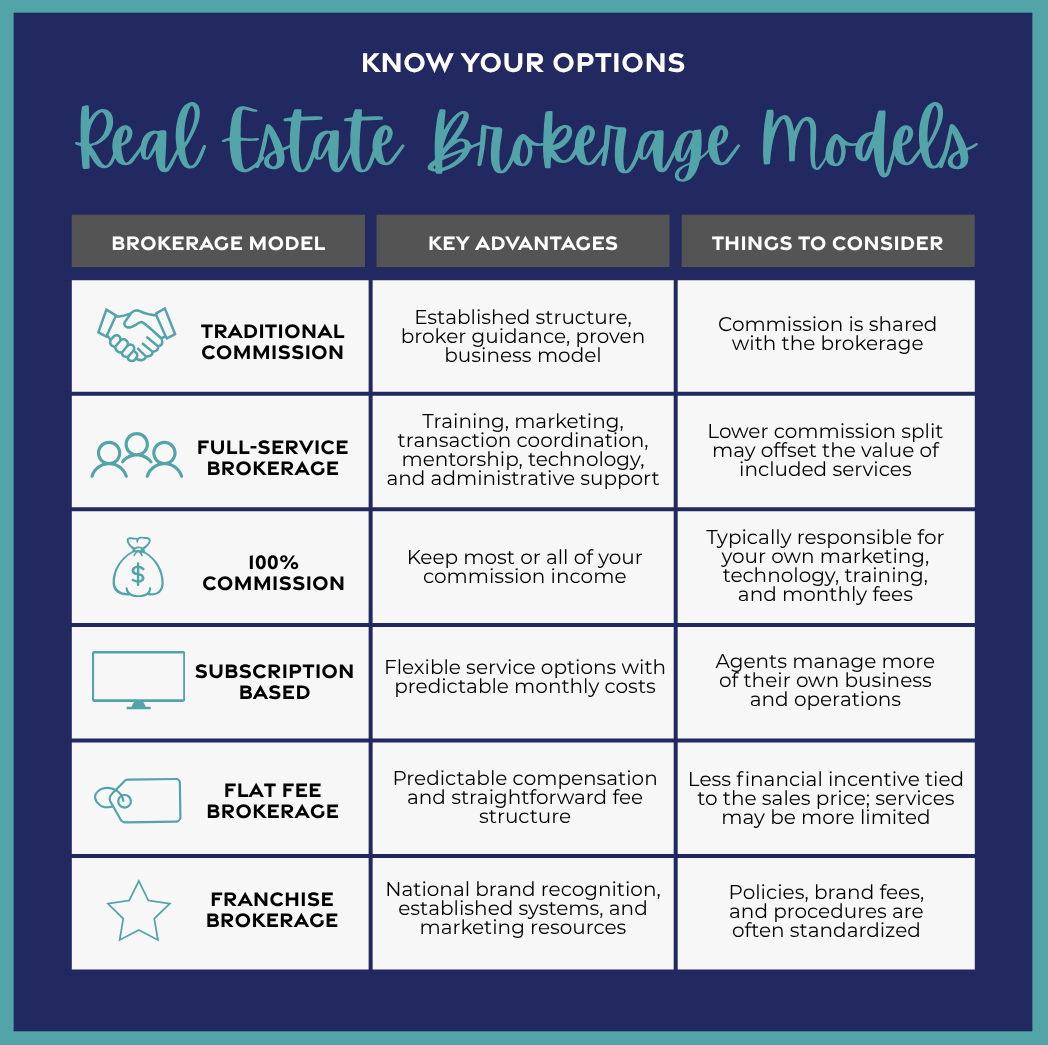
None of these models are inherently better than another. The right fit depends on your experience, goals, and preferred way of doing business. Here's a breakdown of the different types of real estate brokerages for agents along with commission split information (where applicable):
If you've ever seen a brokerage advertise a 50/50, 60/40, 70/30, or 100% commission plan, you may have wondered what those numbers actually mean.
The first number represents the agent's share of the commission, while the second number represents the brokerage's share. For example, on a 60/40 split, the agent keeps 60% of the commission earned on a transaction, and the brokerage retains 40%. So, in the simplest terms, if an agent earns a $10,000 commission, the agent would receive $6,000 and the brokerage would receive $4,000.
It's also important to remember that the commission split is only one part of the compensation structure. Some brokerages with higher splits may charge:
Know how much these things cost, if you will have to cover the cost of them on your own.
When comparing brokerages, it's often more helpful to look at the overall value and your net income rather than focusing on the split percentage alone. Many experienced agents evaluate a brokerage based on net income and value received, not simply the headline commission split.
Traditional brokerages have been the foundation of the real estate industry for decades. Agents typically split each commission with the brokerage, and in return receive office space, management oversight, training, marketing resources, and administrative support. It can provide structure, mentorship, and opportunities to learn from experienced professionals.
Typical commission splits: Newer agents can start around a 50/50 or 60/40 split, while others may negotiate 70/30 or 80/20. Some brokerages also increase the split as production grows. It is not uncommon for these types of brokerages to charge transaction fees, technology fees, marketing fees, and/or brand fees. It is also not uncommon for you to carry the cost of things like photography, videography, systems, and lead generation.
A full-service brokerage takes the traditional model a step further by offering a comprehensive suite of services designed to help agents grow their business. These brokerages often provide professional marketing, transaction coordination, photography, technology platforms, coaching, lead generation tools, and ongoing education. The goal is to allow agents to spend more time serving clients while the brokerage handles many of the behind-the-scenes tasks. Although commission splits or fees may be higher, agents who value support and scalability often find this model provides significant value.
Typical commission splits: Similar to a traditional brokerage where agents can start around a 50/50 or 60/40 split, but without any added fees. This type of brokerage will often also provide an assistant, property marketing (drone, photos, videos), signs, lockboxes, systems, and lead generation. The heavy investment in the agents is intended to allow the agents to focus less on the administrative tasks of being a real estate agent, and more on taking care of their current clients and earning new clients. It is also not uncommon for these types of brokerages to require their agents to be full-time, producing agents in order to justify the out-of-pocket costs for the brokerage.
A 100% commission brokerage allows agents to keep nearly all of the commission they earn, typically in exchange for a monthly fee, transaction fee, or annual cap. This model is popular among experienced agents who already generate consistent business and don't require extensive training or brokerage-provided services. Because agents are responsible for many of their own expenses, including marketing, technology, and transaction management, success often depends on having an established business and strong organizational skills.
Subscription-based brokerages replace traditional commission splits with a predictable monthly membership fee where additional services are often available à la carte. Agents generally retain most or all of their commission while paying a recurring subscription that covers access to the brokerage's platform, compliance, and basic services. Depending on the brokerage, additional services such as marketing, transaction coordination, or lead generation may be available for an extra fee. This model appeals to agents who appreciate predictable business expenses and the flexibility to choose only the services they need.
Flat fee brokerages charge agents a fixed amount for each transaction instead of taking a percentage of the commission. This can make financial planning more predictable, particularly for agents who work with higher-priced properties where percentage-based splits can become expensive. However, agents should carefully evaluate what services are included, as support levels can vary significantly from one brokerage to another. Some provide only compliance oversight, while others offer additional administrative or marketing assistance.
Franchise brokerages operate under nationally or internationally recognized brands. Independent brokerage owners license the brand name and business systems while providing local management and support. Agents often benefit from established brand recognition. It's worth researching if your local market prefers more local or franchise brokerages.
At the same time, the day-to-day experience can vary considerably because each franchise office is independently owned and operated. Culture, leadership, commission structures, and support may differ from one office to another, even within the same brand.
Because every franchise office is independently owned and operated, commission structures vary considerably. One office may offer a 60/40 split with extensive training, while another under the same national brand may offer an 70/30 split with fewer brokerage-provided services.
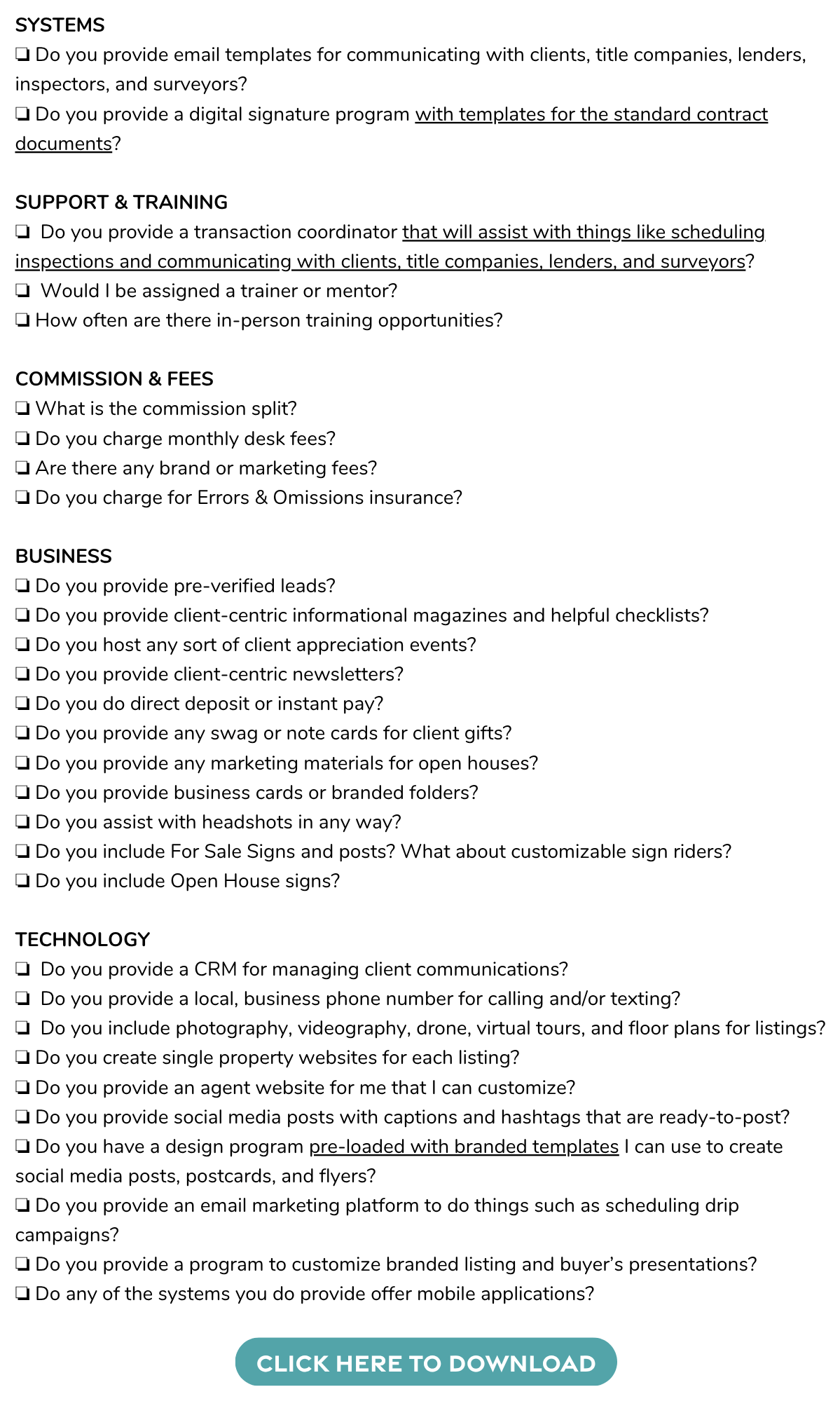
It's easy to compare what you'll pay a brokerage. It's much more important to understand what you'll receive in return.
Here are some questions worth asking (remembering to choose what is important to you):
Sometimes paying a little more for exceptional support can actually help you build your business much faster.
You're going to spend a lot of time around your fellow agents.
Ask yourself:
A collaborative environment often leads to faster learning and a much more enjoyable career.
See if the broker has some agent video testimonials on their website, or ask the broker if you can sit with some current agents on the team.
Many new agents focus on surviving their first transaction. Instead, think about where you want to be three or five years from now.
Do you eventually want to build a team?
Invest in real estate?
Specialize in luxury homes, land, commercial properties, or first-time buyers?
Choose a brokerage that supports those long-term goals instead of only meeting your immediate needs.
National brands certainly have recognition, but a recognizable logo doesn't automatically translate into better training, stronger mentorship, or happier clients.
Many independent brokerages provide highly personalized coaching, local market expertise, innovative marketing, and a culture that's difficult to replicate in larger organizations.
The brokerage's reputation in your local market, and how it supports its agents every day, is often far more important than the name on the sign.
Many agents feel nervous during brokerage interviews because they think they're the ones being evaluated.
The truth is, you're interviewing them.
Ask questions.
Request examples.
Talk with current agents.
Find out what support actually looks like after your first week (not just during onboarding).
A good broker should welcome those conversations.
Every brokerage has strengths, and every agent has different goals.
Some agents thrive with independence. Others want daily coaching. Some prefer a large office environment, while others value a close-knit team.
The most successful agents usually aren't the ones who chase the highest split or the biggest name. They're the ones who choose an environment where they can continuously learn, serve their clients well, and build a sustainable business.
Take your time, ask thoughtful questions, and choose a brokerage that invests in your success (not just your production).
Stay up to date on the latest real estate trends.

All Real Estate News
October 17, 2026

All Real Estate News
October 16, 2026

All Real Estate News
October 15, 2026

All Real Estate News
October 14, 2026

Articles for Buyers
October 13, 2026

All Real Estate News
October 12, 2026
You’ve got questions and we can’t wait to answer them.