Data Centers Are Moving Closer to Homes. What Does That Mean?
September 16, 2026
All Real Estate News
September 16, 2026
All Real Estate News
Data centers probably weren't on your list of things to think about when selling or buying a home.
School districts? Sure. How close you are to work, shopping, restaurants or family? Absolutely. A massive building full of computer servers with an enormous appetite for electricity? Probably not.
But data centers are becoming a much bigger real estate conversation across the country. And now, they're becoming a local conversation too.
Leon County is considering a proposed 18-month moratorium on certain large-load facilities, including large-scale data centers, in unincorporated Leon County. The idea is to give local officials time to study the potential effects and decide whether the County's development rules should change before an application arrives.
That's an important distinction.
This is not a response to an approved data center suddenly coming to Tallahassee. It is local government trying to answer some pretty big questions before it has to make a decision on an actual project.
The reason this issue is reaching more local governments is pretty simple: data centers are spreading.
According to Realtor.com, only 12 U.S. ZIP codes contained a large data center of at least 50 megawatts in 2015. By June 2026, that number had grown to 108 ZIP codes, and Realtor.com projects it could reach 125 by the end of the year.
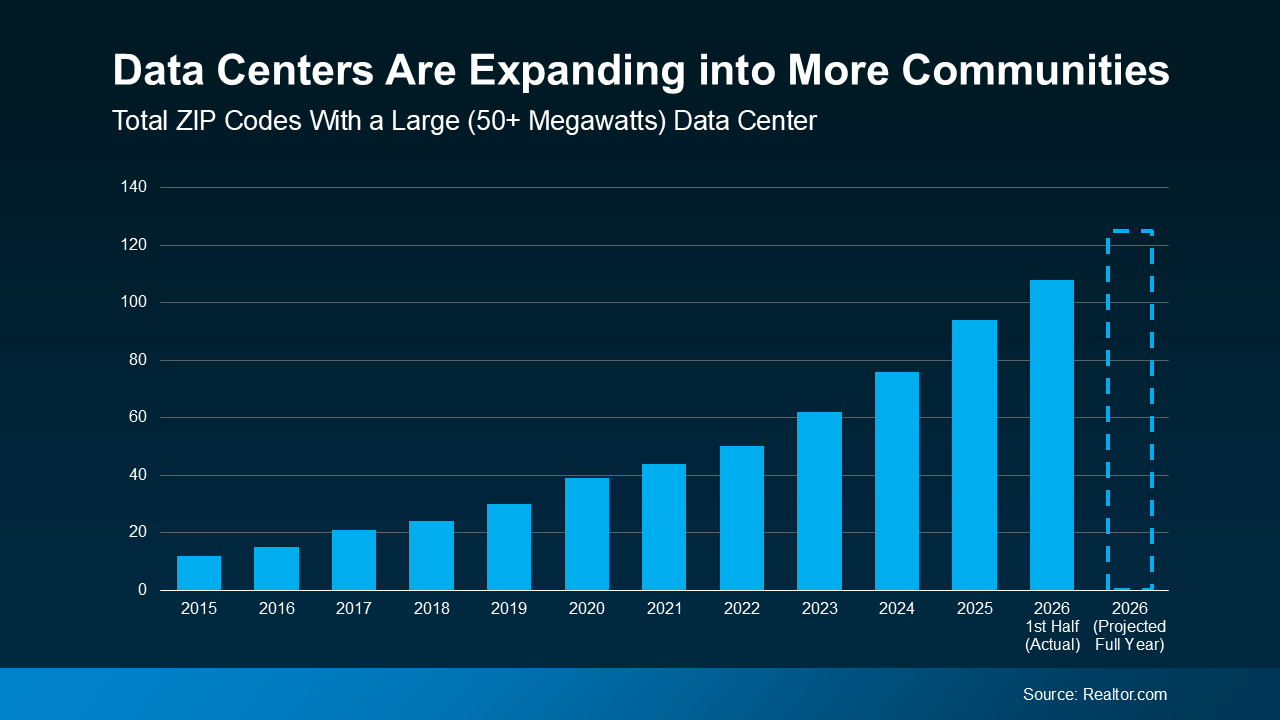
That is a pretty dramatic expansion in a little more than a decade.
And these facilities are changing too. Realtor.com found that the average new data center opening in 2018 used about 24 megawatts of power. By 2026, that figure had risen to roughly 60 megawatts.
As the facilities get larger and spread into more communities, questions about electricity, water, land use, noise, infrastructure and nearby property values are naturally following them.
Leon County commissioners started formally discussing the issue earlier this summer.
On July 14, the Board voted 7-0 to direct County staff to prepare an ordinance for an 18-month temporary moratorium involving large-load customers, including large-scale data centers.
The proposed ordinance would temporarily pause the acceptance, review or approval of certain development permits, development orders, rezonings and site plans for those facilities in unincorporated Leon County.
The County has scheduled two public hearings, one for September 15 and another for October 13, both at 6 p.m. The September 15 agenda specifically identifies the item as the "First of Two Public Hearings" on adopting the proposed 18-month moratorium.
So, as of right now, the moratorium has not been formally adopted.
The July vote authorized staff to draft the ordinance and bring it back through the public-hearing process.
The goal is essentially to give the County time to research the issue before making longer-term decisions about where these facilities could go and what rules should apply to them.
And Florida law specifically leaves local governments with authority over comprehensive planning and land-development regulations involving these large-load facilities. Florida's new data-center legislation also addresses electricity costs, water use and a statewide study of their broader impacts.
The City has been discussing the issue separately from Leon County.
In June, Tallahassee City Commissioner Jeremy Matlow proposed a one-year city moratorium on data centers. That motion failed 3-2.
During that discussion, City Manager Reese Goad said Tallahassee's existing comprehensive plan and land-use ordinances do not currently allow data centers. He also said supporting a major facility would require the City to dramatically increase its utility capacity.
So there are two different local-government situations to keep straight.
Leon County is considering an 18-month moratorium for certain facilities in unincorporated Leon County.
The City of Tallahassee has not adopted a similar moratorium, but City staff has said existing land-use rules do not presently allow a large-scale data center.
In other words, this is currently much more of a planning conversation than an announcement that a data center is headed to Tallahassee.
For sellers, homeowners and buyers, one of the obvious questions is whether living near a data center could affect property values.
So far, the national research doesn't support a simple answer like "data centers lower home values."
Realtor.com compared 43 ZIP codes where a large data center opened between 2019 and 2025 with similar communities. In the two years after the facilities opened, home values in the data-center ZIP codes generally tracked the comparison areas, with no statistically meaningful difference in sale or listing prices.
That's reassuring, but it isn't the same as saying a data center can never affect an individual property.
The research is looking at entire ZIP codes.
A house directly beside a large facility, transmission equipment or a major construction site could have a very different experience than a home several miles away.
Noise, visibility, traffic, buffers, surrounding land use and the particular facility could all matter.
And Realtor.com itself cautions that the next generation of data centers is larger and more power-intensive than many of the facilities included in the historical research.
So the better conclusion is probably this: proximity to a data center does not automatically mean home values rise or fall, but the specifics of the location matter.
Like almost any major development, a data center can bring potential benefits along with legitimate questions.
On the positive side, a facility may generate tax revenue, encourage infrastructure investment and contribute to economic activity. New electric, fiber and road infrastructure may also accompany major development.
But communities are also looking closely at the other side of the equation.
Large facilities can involve cooling equipment, backup generators, substations, transmission infrastructure, truck traffic and construction. Depending on the site and facility design, noise and appearance can become concerns for nearby property owners.
Then there is resource use.
Large-scale data centers require substantial amounts of electricity. Some cooling systems can also consume significant amounts of water.
Those concerns are important enough that Florida's 2026 data-center legislation requires utilities to develop rules intended to ensure large-load customers pay for their own cost of electric service rather than shifting that risk to the broader body of ratepayers. The law also creates specific requirements involving water permits for large-scale data centers.
That doesn't mean a data center automatically makes everyone's utility bill go up.
It means state and local governments are actively trying to answer the question of who pays for the infrastructure needed to serve them.
This may be the most important part of the whole article.
There is a big difference between discussing data-center regulations and having a specific data-center development headed your way.
Right now, the local conversation is about planning.
Leon County commissioners have directed staff to develop a temporary moratorium while the County studies large-load facilities and considers longer-term regulations. The proposed ordinance still has to go through its public hearings before adoption.
Within the City of Tallahassee, the City Manager has said current land-use regulations do not permit a data center and that the municipal utility system could not presently support one of these major facilities without significant expansion.
So this isn't a story about a data center breaking ground down the road.
It's a story about local officials deciding what the rules should be before that question lands on their desk.
For Tallahassee sellers, there's no reason to assume the national data-center boom is currently affecting your home's value.
If a major facility were ever proposed near a property, however, buyers would likely have questions. Knowing the actual location, proposed buffers, zoning, construction timeline, infrastructure plans and surrounding future land uses would be much more useful than simply saying there's a "data center nearby."
For buyers, this is a good reminder that researching a home means looking beyond what you can see from the driveway today.
Current zoning, future land-use designations, proposed commercial developments, rezonings, transportation projects and other major infrastructure can all influence how an area changes over time.
That doesn't mean you need to predict every possible future development before buying a house.
But it does mean knowing what has actually been approved, what has merely been proposed and what is only being discussed.
Those are three very different things.
Data centers are not changing the Tallahassee housing market today, but they have officially become part of the local land-use conversation.
Leon County is considering an 18-month pause on certain large-load development applications while it studies the issue. The City of Tallahassee has not adopted a moratorium, but City staff has said current land-use rules do not allow a large-scale data center and the existing utility system is not equipped to support one without major expansion.
For sellers and buyers, the larger lesson goes beyond data centers.
What's planned around a property can matter almost as much as what's there today. And when a big development makes headlines, it's worth separating what has actually been approved from what local officials are simply preparing for.
In this case, Tallahassee and Leon County are doing a lot of talking and planning before a large-scale data center is actually on the table.
Stay up to date on the latest real estate trends.
All Real Estate News
October 23, 2026
All Real Estate News
October 21, 2026
All Real Estate News
October 20, 2026

Articles for Buyers
October 19, 2026

October 19, 2026

All Real Estate News
October 17, 2026
You’ve got questions and we can’t wait to answer them.