Does the Fed Control Mortgage Rates? Here's Why the 10-Year Treasury Matters More Than You Think.
October 25, 2026
All Real Estate News
October 25, 2026
All Real Estate News
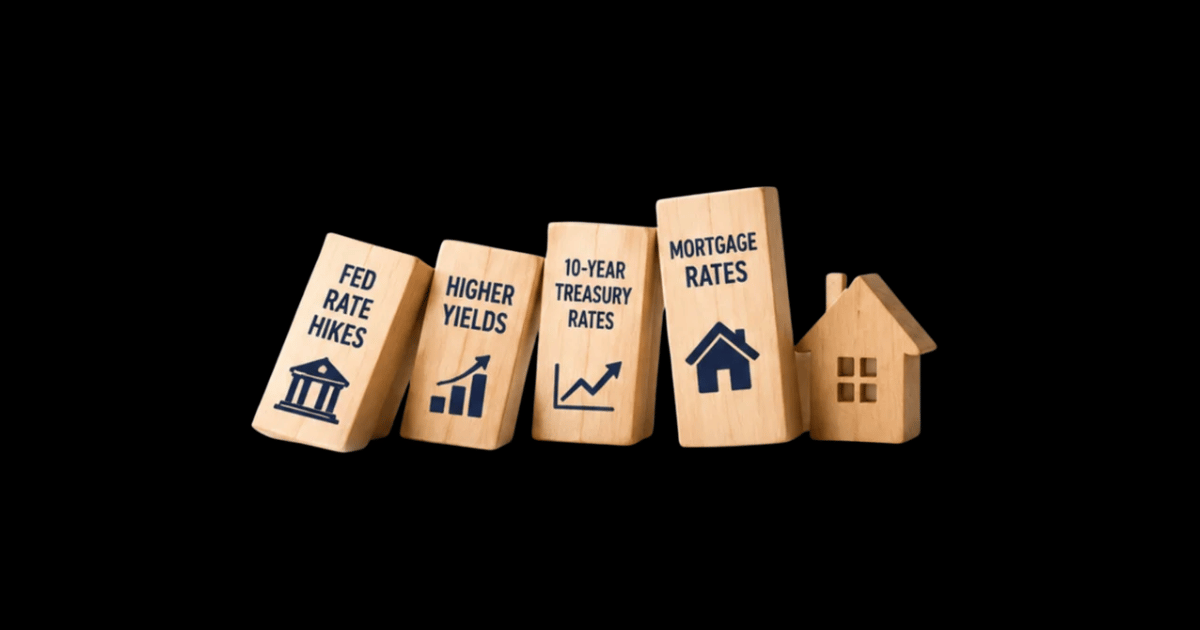
Every time the Federal Reserve announces an interest rate decision, homeowners, sellers, and buyers start watching the headlines. If the Fed raises rates, mortgage rates must be going up, right? And if the Fed cuts rates, shouldn't mortgages get cheaper?
Not necessarily.
Here's something that surprises a lot of people: The Federal Reserve does not directly set mortgage rates. While its decisions influence borrowing costs throughout the economy, the interest rate on a 30-year mortgage is more closely associated with something many people have never thought to watch: the 10-year U.S. Treasury yield.
So, what's the connection between the Fed, Treasury bonds, and mortgage rates? And why should anyone considering selling or buying a home right now.
Let's break it down.
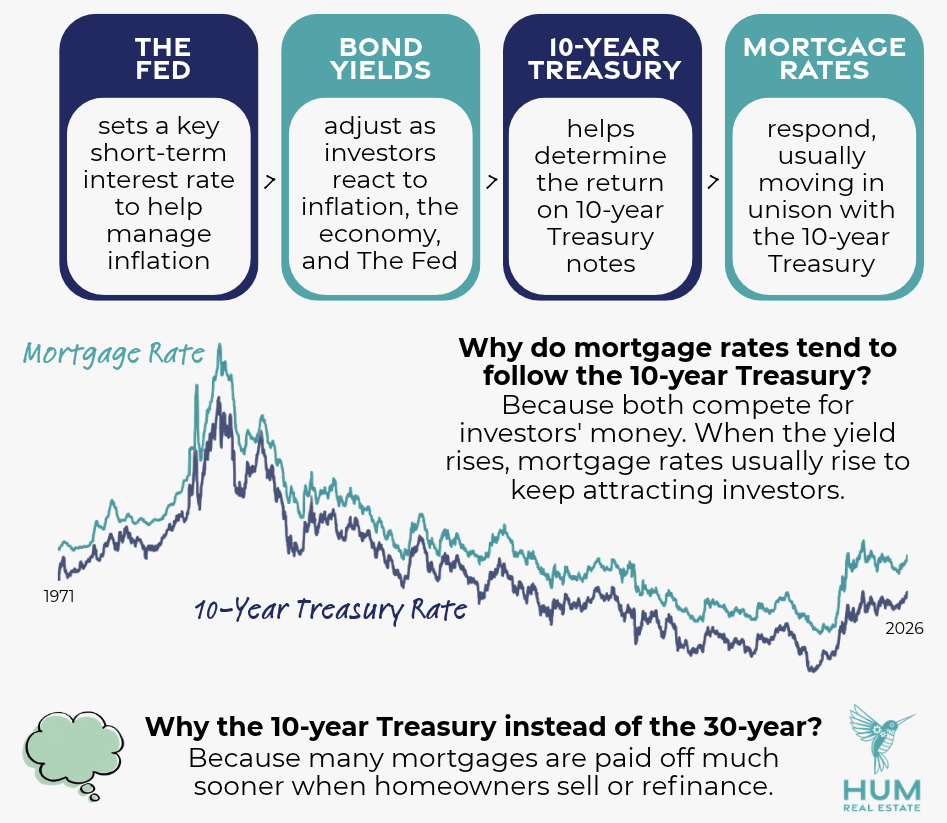
The Federal Reserve, commonly called the Fed, has two primary responsibilities: supporting maximum employment and maintaining stable prices. To help manage inflation and economic activity, it adjusts a benchmark interest rate known as the federal funds rate.
The federal funds rate influences short-term borrowing costs throughout the economy, including interest rates associated with credit cards, variable-rate loans, and home equity lines of credit (HELOCs).
In September 2026, the Fed raised its benchmark rate by 0.25 percentage points, bringing the target range to 3.75%–4.00%. It was the first increase in approximately three years.
But here's where things get interesting.
The Fed can raise its benchmark interest rate without mortgage rates increasing by the same amount. Mortgage rates can even move in the opposite direction.
That's because mortgage rates are determined by financial markets, not directly by the Federal Reserve.
When the federal government needs to borrow money, it issues Treasury securities. Investors purchase these securities and receive interest in return.
A 10-year Treasury note is essentially a loan to the federal government with a 10-year term.
The interest rate investors earn is called the Treasury yield, and that yield changes as investors buy and sell Treasury securities.
Here's the important part: When Treasury prices rise, their yields generally fall. When Treasury prices fall, their yields generally rise.
Those movements are influenced by economic growth, inflation expectations, global events, investor demand, and expectations about future Federal Reserve policy.
And because Treasury securities are considered relatively low-risk investments, their yields provide an important benchmark for other borrowing costs, including mortgages.
This is where everything starts to make sense.
You might assume that a 30-year mortgage would follow the 30-year Treasury. After all, both have 30-year terms.
But most homeowners don't keep the same mortgage for 30 years.
Some sell their homes. Others refinance. And some pay off their loans early.
Consequently, mortgage investors often receive their money back substantially sooner than the original 30-year repayment schedule.
The 10-year Treasury has historically served as a useful benchmark for mortgage financing because its duration is closer to the expected life of many mortgages.
According to the Federal Reserve Bank of St. Louis, mortgage rates can be understood as the 10-year Treasury yield plus an additional spread that accounts for lending risks, expenses, and other factors.
That spread helps explain why mortgage rates are higher than Treasury yields.
For example, if the 10-year Treasury yield is 5%, that doesn't mean a mortgage will carry a 5% interest rate. Mortgage investors require additional compensation for risks associated with home loans.
The important takeaway is that the 10-year Treasury yield and 30-year mortgage rates tend to move in the same direction over time, although not always by the same amount or at exactly the same time.
Even though the Federal Reserve doesn't directly set mortgage rates, its actions still matter.
Think of the Fed as one of the most influential voices in the financial markets, rather than someone controlling a giant mortgage-rate dial.
When the Fed announces an interest rate decision, investors aren't just paying attention to what happened. They're also considering what that decision suggests about inflation, economic growth, and future interest rates.
If investors anticipate persistent inflation or higher future interest rates, they may demand higher yields from long-term investments.
Conversely, if investors become more confident that inflation will decline, Treasury yields may fall.
Mortgage rates can respond to those changes in investor expectations.
This also explains why mortgage rates sometimes change before the Fed makes an announcement. Investors frequently adjust their expectations weeks or months in advance.
By the time the Fed announces a decision, some or all of that expectation may already be reflected in mortgage rates.
Mortgage rates have experienced considerable volatility this year, influenced by inflation concerns, geopolitical developments, energy prices, and changing expectations about monetary policy.
According to Freddie Mac, the national average 30-year fixed mortgage rate reached 7.40% on October 15, 2026.
One week later, on October 22, the average eased to 7.32%.
Meanwhile, the 10-year Treasury yield fell below 5% on October 22, after trading above that level earlier in the month.
Although mortgage rates and Treasury yields don't move in perfect synchronization, their recent behavior provides another example of how closely the two markets are connected.
A small decline doesn't necessarily signal a lasting downward trend. Inflation reports, economic developments, and changes in investor sentiment could quickly influence borrowing costs again.
And that brings us to the question everyone wants answered.
Maybe. But a Fed rate cut does not guarantee lower mortgage rates.
If the Fed cuts its benchmark rate because inflation is declining and economic conditions are stabilizing, Treasury yields and mortgage rates may decline as well.
However, if investors are worried that inflation will remain elevated, long-term borrowing costs could stay high even when the Fed lowers short-term rates.
In fact, mortgage rates can rise following a Fed rate cut if bond investors become more concerned about future inflation or economic conditions.
It's a reminder that the housing market responds to more than one economic indicator.
So, rather than watching only the Federal Reserve's announcements, it's worth paying attention to the 10-year Treasury yield, inflation reports, employment data, and broader bond market activity.
National mortgage rates may dominate the headlines, but their effects are ultimately felt locally.
Here in Tallahassee, September 2026 housing statistics showed closed sales down 6.2% compared to the previous year, while pending inventory increased 8.6%. Homes that went under contract did so faster than a year earlier, and the market maintained approximately 3.8 months of inventory.
These numbers suggest that local real estate conditions are more nuanced than a single national mortgage-rate headline might indicate.
For sellers, mortgage rates influence how much prospective purchasers can afford each month. When financing costs rise, some buyers may need to adjust their budgets, making realistic pricing and effective property marketing especially important.
Offering concessions toward closing costs or a mortgage rate buydown may also be worth discussing, depending on the property's price point, competing listings, and the seller's goals.
For buyers, mortgage rates are important, but they're only one part of the financial picture.
Comparing mortgage offers from multiple lenders, evaluating potential seller concessions, and understanding the full monthly payment can sometimes make a greater difference than waiting for a relatively small change in the national average rate.
The Consumer Financial Protection Bureau recommends comparing offers from multiple lenders because interest rates, fees, and loan terms can vary considerably.
The next time you hear that the Federal Reserve is raising, lowering, or holding interest rates steady, remember that it doesn't directly control what you'll pay for a mortgage.
The 10-year Treasury yield provides a more useful indicator of where longer-term mortgage rates may be headed, but inflation, investor demand, lending conditions, and broader economic developments all contribute to the final number.
For sellers, understanding these relationships can help inform pricing, timing, and negotiating strategies.
For buyers, it can help separate the national headlines from the actual financing opportunities available.
The goal isn't necessarily to predict the next move in mortgage rates. It's to understand what influences them and make informed decisions based on your circumstances.
Stay up to date on the latest real estate trends.
All Real Estate News
October 25, 2026

All Real Estate News
October 23, 2026

All Real Estate News
October 23, 2026

All Real Estate News
October 21, 2026

All Real Estate News
October 20, 2026

Articles for Buyers
October 19, 2026
You’ve got questions and we can’t wait to answer them.