Don't Let Student Loans Put Your Homeownership Plans on Hold
August 10, 2026
All Real Estate News

August 10, 2026
All Real Estate News
Student loans are back in the headlines. And if you're hoping to buy a home in Tallahassee, seeing your student-loan balance alongside today's home prices may leave you wondering whether homeownership needs to wait.
Here's the good news: having student loans doesn't automatically mean you can't buy a home.
In fact, student debt is surprisingly common among people who successfully make the jump into homeownership.
One misconception we hear from prospective first-time buyers is that student loans need to be completely paid off before they can qualify for a mortgage.
That's simply not a universal rule.
Mortgage qualification is based on a much bigger financial picture. Your lender will look at factors including your income, monthly debt obligations, credit profile, available cash, the mortgage program you're using and the price of the home you're trying to purchase.
And that's an important distinction: the total amount you owe in student loans isn't necessarily the same thing as the amount a mortgage lender will count against you each month.
Different mortgage programs have different guidelines for calculating student-loan obligations, particularly when loans are deferred, in forbearance or on an income-driven repayment plan. That's one reason two people with identical student-loan balances could have very different mortgage qualifications.
Instead of assuming your student debt disqualifies you, a lender can look at the actual numbers and determine how that debt would be treated under the mortgage programs available to you.
And here's some pretty compelling evidence that student loans and homeownership aren't mutually exclusive.
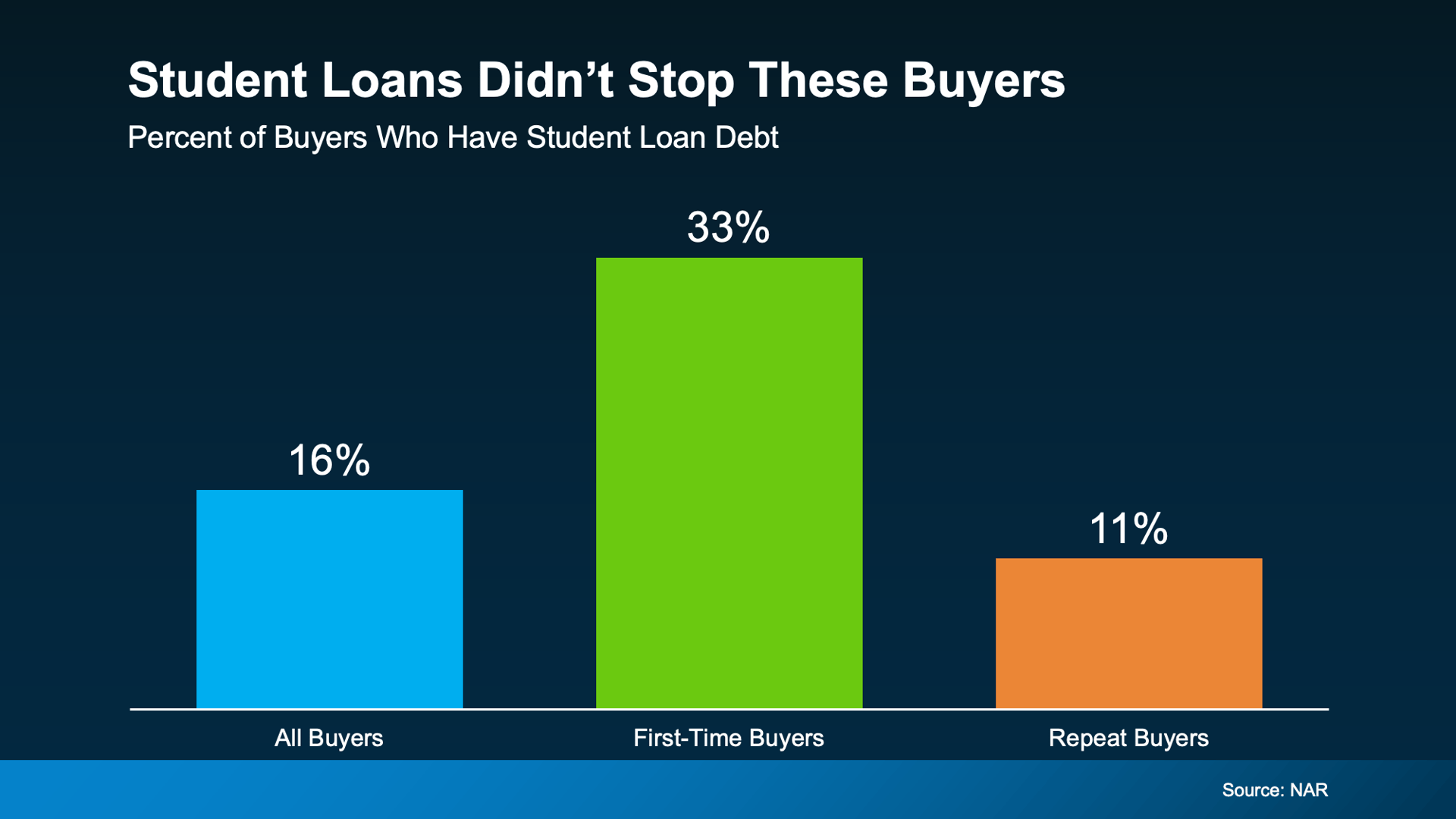
According to the National Association of REALTORS® 2025 Profile of Home Buyers and Sellers, 33% of first-time buyers had student-loan debt when they purchased their home. The median student-loan balance among those first-time buyers was $30,400.
That's roughly one out of every three first-time buyers.
So, while student debt can absolutely affect someone's purchasing power, the data shows it isn't automatically a barrier to becoming a homeowner.
Here's where our local housing market makes the conversation more interesting.
The median sales price of a Tallahassee residential home sold in July 2026 was $297,000, while the average sales price was $362,830.
But first-time buyers aren't necessarily shopping at either of those numbers.
We've been using roughly $200,000 as an entry-level benchmark for Tallahassee first-time buyers, and there are still homes available around that price point.
As of our latest market check, there were:
That's 831 active listings at or below $300,000.
Of course, not every one of those properties will fit every buyer, qualify for every financing program or meet the same condition and location needs. But the numbers help illustrate an important point: starting a home search in Tallahassee doesn't automatically mean shopping at the city's average sales price.
Imagine two Tallahassee buyers who each owe $30,000 in student loans.
One may have a relatively low documented monthly student-loan payment, limited additional debt, good credit and money saved for the purchase.
The other may have higher monthly debt obligations, a car payment, revolving credit-card balances and less cash available.
They technically have the same amount of student debt, but their homebuying options could look completely different.
That's why focusing exclusively on the student-loan balance can be misleading.
A mortgage professional can evaluate how your student loan will actually be treated for the particular mortgage programs you may qualify for and then look at that payment alongside your income and other monthly obligations.
There's another reason not to automatically count yourself out: some Tallahassee-area first-time buyers may qualify for down-payment and closing-cost assistance.
Leon County currently says funds are available for eligible first-time homebuyers seeking down-payment assistance through the Tallahassee Lenders' Consortium. The program requires things like homebuyer education, and at least $500 from the applicant toward the down payment or closing costs.
That's especially important for someone juggling student-loan payments while also trying to save enough cash to purchase a home.
This may be the biggest takeaway.
You don't need to figure out on your own whether your student loans make homeownership possible. And you definitely don't need to wait until the balance reaches $0 before even asking.
A good first step is talking with a knowledgeable local lender and having them run the numbers.
Ask how your current student-loan payment will be calculated, what your debt-to-income ratio looks like, which mortgage programs may fit your situation, how much cash you would realistically need and whether you might qualify for local assistance programs.
You may find out you need some time to improve your financial position before buying. That's useful information too because now you have an actual roadmap instead of an assumption.
Or you may discover you're closer than you thought.
Student loans can affect how much home you qualify to purchase, but having student debt doesn't automatically take homeownership off the table.
That's true nationally, where one-third of first-time buyers with student debt successfully purchased a home, and it's worth exploring here in Tallahassee, where hundreds of homes are currently listed below the city's median sales price.
Before putting your plans on hold, talk with a lender who can look at your income, monthly student-loan payment, other debts, credit, available cash and potential mortgage programs together.
The question isn't simply, "Do I have student loans?"
It's "What do my actual numbers allow me to do?"
Stay up to date on the latest real estate trends.

Monthly Market Updates
September 21, 2026

All Real Estate News
September 21, 2026
All Real Estate News
September 18, 2026
All Real Estate News
September 17, 2026
All Real Estate News
September 16, 2026
All Real Estate News
September 15, 2026
You’ve got questions and we can’t wait to answer them.