How Fed Rate Hikes Affect Home Sellers and Buyers
October 14, 2026
All Real Estate News
October 14, 2026
All Real Estate News
If you're thinking about selling or buying a home, you've probably noticed mortgage rates making headlines again. And lately, those headlines haven't been particularly encouraging.
On September 16, 2026, the Federal Reserve raised its benchmark interest rate by 0.25 percentage points, bringing its target range to 3.75%–4.00%.
Meanwhile, mortgage rates have been climbing. According to Freddie Mac, the average 30-year fixed mortgage rate reached 7.40% on October 8, compared with 6.76% just four weeks earlier.
For homeowners considering a move, that can mean a more expensive mortgage on their next property. For prospective homebuyers, it means less purchasing power.
But there's an important distinction that often gets lost in the headlines: The Fed doesn't actually set mortgage rates.
And understanding what really drives them can help you make better decisions in today's real estate market.
The short answer is inflation.
When the cost of goods and services rises too quickly, your money doesn't stretch as far. Everything from groceries and gasoline to construction materials and insurance can become more expensive.
That's a problem for housing affordability, too.
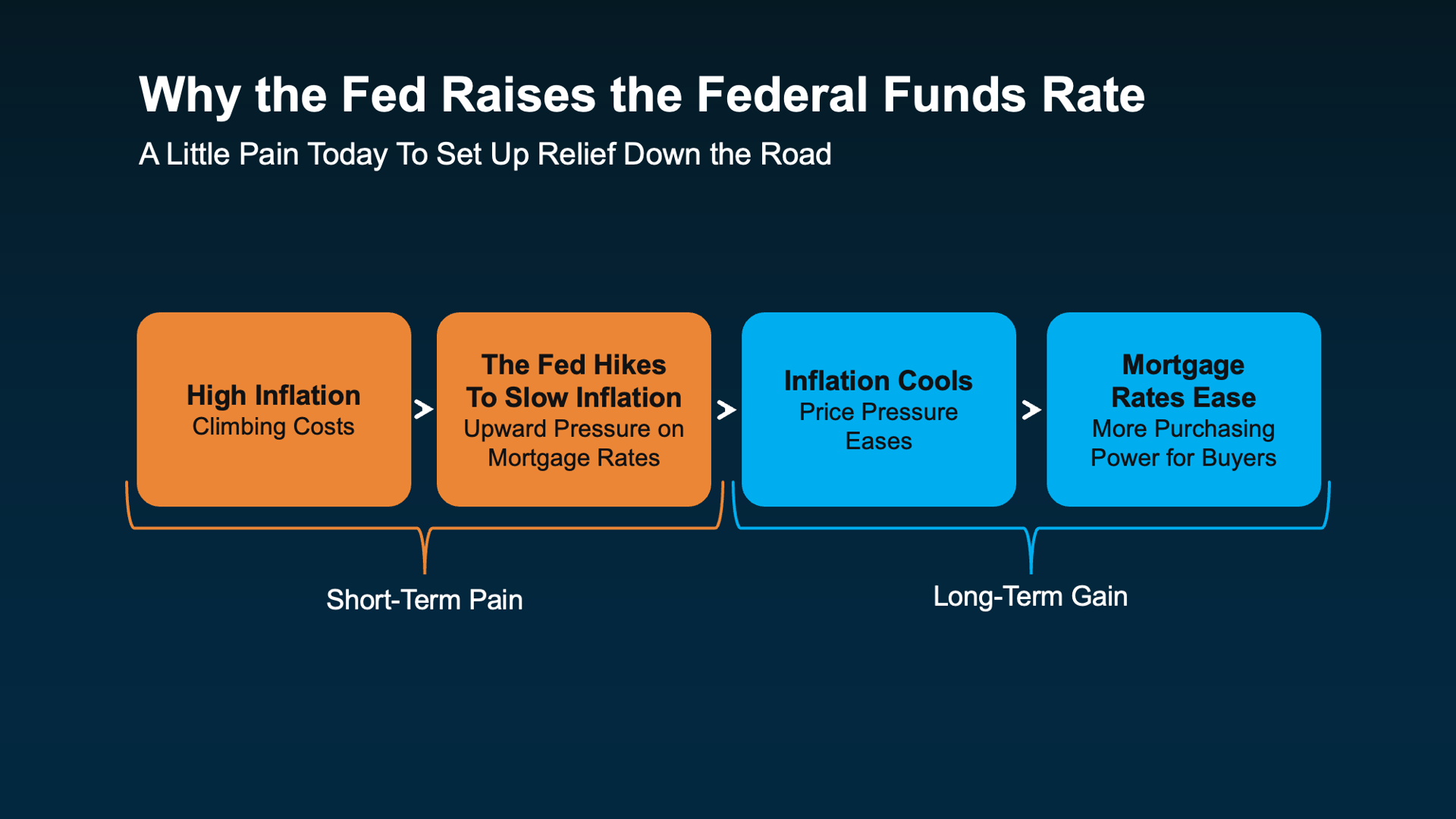
To help control inflation, the Federal Reserve can increase its benchmark interest rate, known as the federal funds rate.
Higher borrowing costs can discourage spending, slow economic activity, and reduce some of the pressure pushing prices upward.
That's the goal, anyway.
The challenge is that raising interest rates can create financial pressure in the short term, even when the Fed hopes those decisions will lead to more stable prices over time.
And this is where mortgage rates enter the picture.
MYTH: When the Fed raises interest rates, mortgage rates automatically increase by the same amount.
REALITY: The Fed influences mortgage rates, but it doesn't directly control them.
The federal funds rate primarily affects short-term borrowing. Mortgage rates are influenced much more directly by longer-term financial markets.
As the Federal Reserve Bank of St. Louis explained in October 2026, mortgage rates depend heavily on expectations about future inflation, interest rates, and economic conditions.
One of the most important indicators is the yield on the 10-year U.S. Treasury note.
When investors expect inflation to remain high, or when they demand greater returns for holding long-term debt, Treasury yields may increase. Mortgage rates often move in the same direction.
Mortgage-backed securities, lender costs, and investor demand also play a role.
That's why mortgage rates can rise before the Fed announces a rate hike, fall after one, or move in a completely different direction than the federal funds rate.
The financial markets aren't just reacting to what the Fed does today. They're constantly adjusting to what investors think will happen tomorrow.
One of the biggest influences on mortgage rates in 2026 has been uncertainty surrounding inflation and the conflict involving Iran.
Disruptions to oil production, shipping, and global energy supplies have contributed to higher fuel prices.
Higher energy costs can affect everything from manufacturing and transportation to the price of everyday goods. And when investors expect those costs to contribute to persistent inflation, longer-term Treasury yields may rise.
That's been particularly noticeable recently.
In early October, Treasury yields climbed amid a combination of geopolitical uncertainty, inflation concerns, and other financial-market pressures.
The result has been a meaningful increase in mortgage rates.
For perspective, consider the impact on a home purchase.
On a $300,000 home with 20% down, the principal and interest payment on a 30-year, $240,000 mortgage would be approximately:
Mortgage Rate | Monthly Principal & Interest |
|---|---|
6.76% | $1,558 |
7.40% | $1,662 |
That's approximately $104 more per month, or $1,242 more per year, simply from the difference in interest rates.
These examples exclude property taxes, homeowners insurance, HOA fees, and other potential costs. Actual mortgage rates depend on individual financing qualifications.
For sellers, changes like this can influence how prospective purchasers evaluate competing homes.
For homebuyers, it can affect both their monthly budget and how much they're able to offer for a property.
There are some encouraging signs, although the inflation picture remains complicated.
According to the Bureau of Economic Analysis, the Personal Consumption Expenditures (PCE) price index increased 3.4% over the 12 months ending in August 2026.
Core PCE, which excludes food and energy and is closely watched by the Federal Reserve, increased 3.0% over the same period.
Both measures were unchanged from July on a year-over-year basis using the latest revised figures.
While inflation has moderated from some earlier readings, it remains above the Fed's long-term 2% target.
And that's important.
The Fed doesn't necessarily need prices to fall. Its goal is to slow the rate at which prices increase while supporting a healthy labor market.
If inflation expectations become more stable, longer-term Treasury yields could eventually decline. That may help create an environment where mortgage rates can ease.
But lower inflation doesn't automatically guarantee lower mortgage rates.
Another rate hike is certainly possible.
According to CME FedWatch, which estimates the probability of Federal Reserve decisions using futures-market pricing, investors were assigning a relatively high probability to additional rate increases as of October 2.
At that time, the probabilities shown were:
Combined, that represented an 85.1% probability of at least one more hike during the remaining scheduled Fed meetings of 2026.
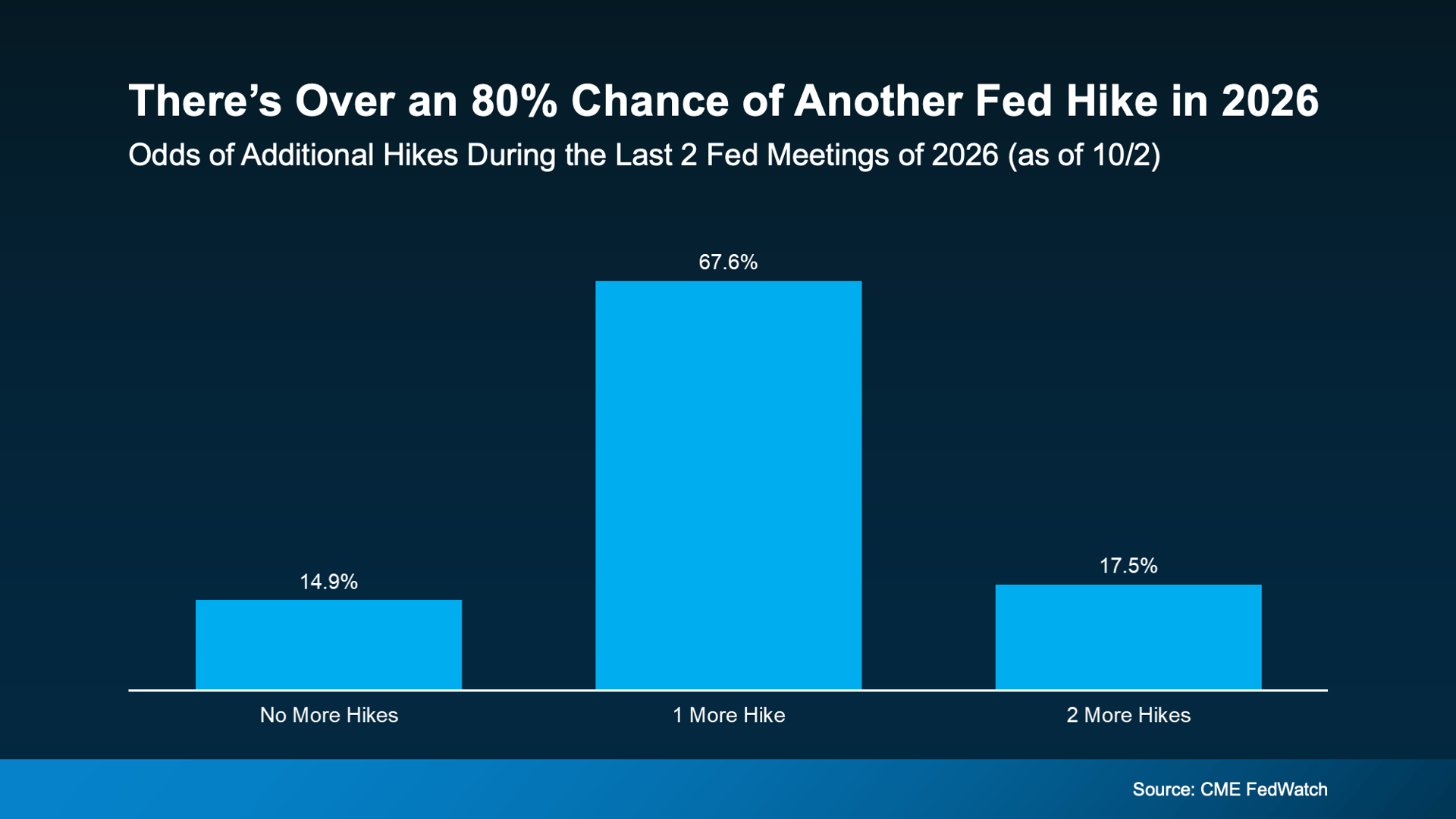
But these are market expectations, not guarantees. The probabilities change as new economic information becomes available.
In fact, expectations for an October hike have already weakened, with investors increasingly anticipating that the Fed may wait until December before making another adjustment.
The remaining scheduled Federal Reserve meetings are October 27–28 and December 8–9.
And even if the Fed raises its benchmark rate again, mortgage rates won't necessarily increase by an identical amount.
Much depends on whether financial markets have already anticipated the decision.
Higher mortgage rates don't just affect people purchasing a home. They can also change what it takes to successfully sell one.
And Tallahassee's current market provides a good example.
According to August 2026 residential data from the Tallahassee Board of REALTORS®, the local market recorded:
These numbers help illustrate why strategic pricing and presentation matter.
With more properties competing for attention, sellers need to consider not only comparable sale prices but also what today's mortgage rates mean for prospective purchasers.
A home that seemed comfortably affordable to someone a month ago may now stretch their budget.
That doesn't necessarily mean sellers need to dramatically reduce their asking prices. But it does mean understanding how buyers compare properties has become increasingly important.
And sometimes, the most effective negotiation tool isn't a price reduction.
Depending on the property, the offer, and financing requirements, sellers may be able to negotiate closing cost assistance or contribute toward a mortgage rate buydown.
For example, a qualified purchaser might find a seller-funded mortgage rate buydown more helpful for their monthly payment than an equivalent reduction in the sale price.
Other purchasers may prefer a lower purchase price, particularly if they have sufficient cash available for closing.
These are different financial arrangements with different costs and benefits. The best approach depends on the property's market position, the buyer's financing, and the seller's expected net proceeds.
For Tallahassee sellers, the takeaway is simple: Price for today's market, make your property stand out, and consider more than one way to negotiate a successful sale.
For anyone planning to purchase a home, mortgage rates are an important part of determining affordability.
But they aren't the only factor.
Home prices, down payment assistance, property taxes, insurance costs, and seller concessions can all affect the financial picture.
There are also ways to evaluate financing options without relying on mortgage rates falling in the future.
Start by getting pre-approved and comparing offers from multiple lenders. Interest rates, discount points, closing costs, and mortgage insurance can vary between loan programs and providers.
Ask your lender about available rate locks, permanent or temporary mortgage rate buydowns, and the total costs involved.
And pay attention to properties that have been on the market longer or have experienced price adjustments. Depending on the circumstances, sellers may be more receptive to negotiating terms.
One important caution: Don't purchase a home based solely on the assumption that you can refinance at a lower rate later.
Refinancing depends on future market conditions, loan qualifications, property values, and closing costs. A lower rate may become available, but there's no guarantee.
The safer approach is to choose a home and mortgage payment that fit your financial situation today, with any future refinancing opportunity treated as a potential benefit.
Several developments could influence mortgage rates through the remainder of 2026.
The most important will be new inflation data, including Consumer Price Index (CPI) and Personal Consumption Expenditures (PCE) reports. These help investors understand whether inflation is moving closer to the Fed's target.
Oil prices and developments involving Iran will also remain important. Any meaningful change in energy supplies or geopolitical risks could affect inflation expectations and Treasury yields.
The Fed's October and December meetings will provide additional insight into how policymakers view the economy and whether further rate increases are necessary.
National mortgage rates influence affordability, but local supply, demand, and pricing determine how those changes play out in our housing market.
The Federal Reserve doesn't control mortgage rates directly, but its policies, inflation expectations, and broader economic conditions can have a significant influence.
With mortgage rates rising again, sellers may need to be more strategic about pricing, marketing, and negotiating incentives. Homebuyers should pay close attention to their financing options and monthly affordability.
The important thing isn't trying to predict the exact day mortgage rates will improve.
It's understanding today's market well enough to make a decision that works for your circumstances.
Stay up to date on the latest real estate trends.

All Real Estate News
November 10, 2026

All Real Estate News
November 10, 2026

Local Events
November 7, 2026

Local Events
November 6, 2026
All Real Estate News
November 4, 2026

All Real Estate News
November 3, 2026
You’ve got questions and we can’t wait to answer them.