Selling a Home? How Builder Incentives Are Changing the Competition
October 7, 2026
All Real Estate News

October 7, 2026
All Real Estate News
Higher mortgage rates don't just affect buyers.
They can change what it takes to sell your home, too.
Today's buyers are paying close attention to affordability, and for good reason. When mortgage rates move higher, even a relatively small change can affect the monthly payment.
That means sellers aren't just competing with the house down the street anymore.
In some price ranges, they're also competing with brand-new homes where builders may be offering reduced mortgage rates, closing-cost assistance, price adjustments or other incentives designed to make the monthly payment more attractive.
And that's happening right here in Tallahassee.
The good news for sellers?
You have ways to compete too.
Nationally, homebuilders have increasingly used incentives to attract buyers who are feeling squeezed by mortgage rates and home prices.
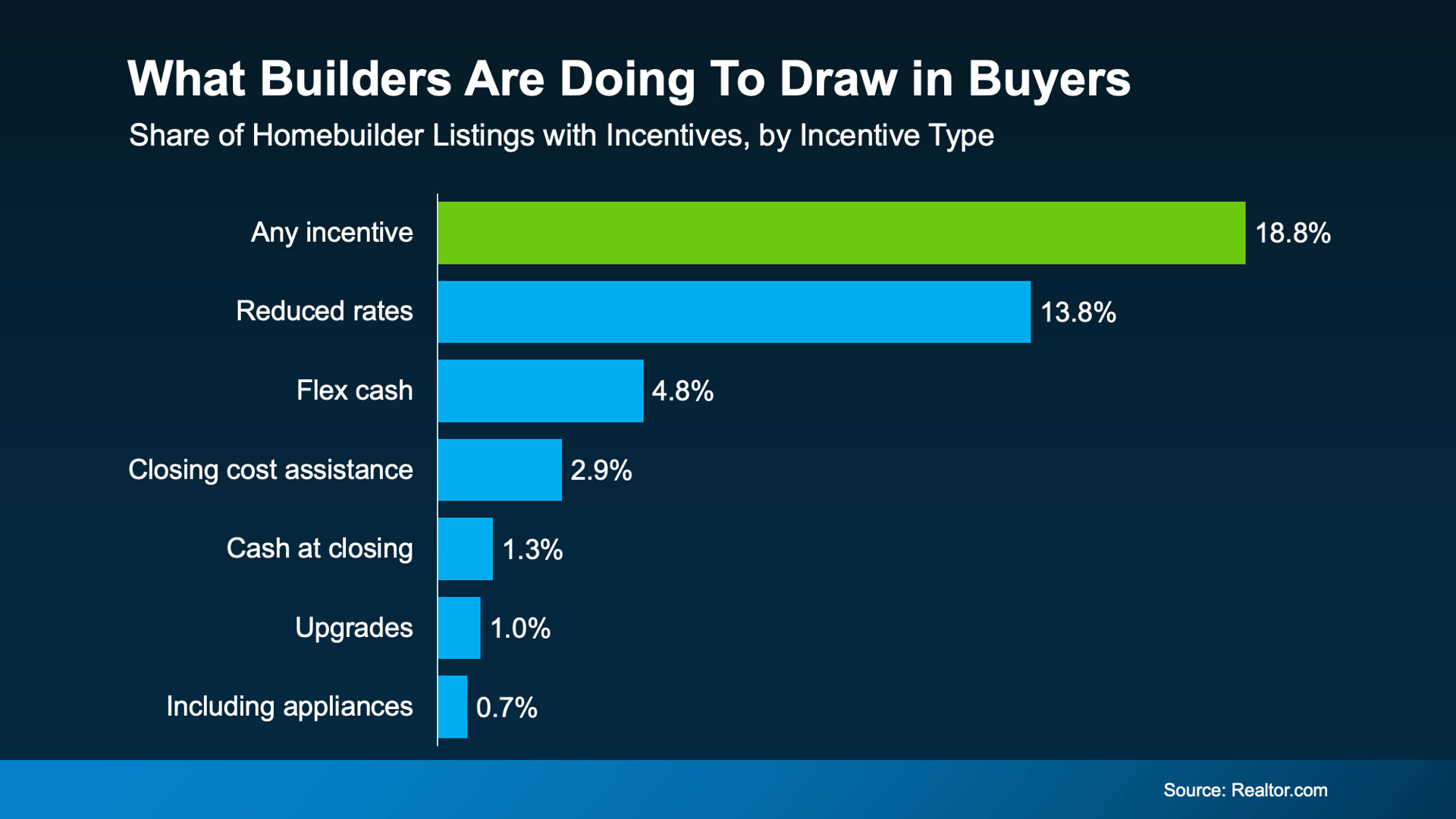
According to Realtor.com, 18.8% of new-construction listings advertised some type of buyer incentive in August 2026.
The most common incentive wasn't a free appliance or upgraded countertop.
It was financing.
Reduced mortgage rates were advertised on 13.8% of new-construction listings, making them by far the most common builder incentive identified in Realtor.com's analysis. Other promotions included flex cash, closing-cost assistance, cash at closing, upgrades and appliances.
That financing piece is particularly important.
A builder may be able to spend money reducing a buyer's mortgage rate rather than simply reducing the home's advertised price.
To a payment-conscious buyer, that can be very appealing.
Realtor.com's national analysis found an average advertised promotional rate of 3.92% among listings offering reduced-rate incentives at the time of its study. But those promotions can have very specific terms, may be temporary or permanent, and may require use of an affiliated or preferred lender. Buyers need to compare the complete loan terms rather than assuming the promotional rate applies to everyone.
This isn't just a trend happening somewhere else.
Current Tallahassee builder listings show examples of the same strategy.
D.R. Horton is presently advertising a “Special Interest Rate” limited-time opportunity on select homes in Tallahassee communities including Fallschase and Legacy Oaks. Select homes in Pine Dove Estates also show special-interest-rate promotions.
That matters if you're selling an existing home in a similar price range.
A buyer may be comparing your home not only with another resale property, but with a brand-new house where the builder is advertising some form of financing assistance.
That doesn't automatically make the new home a better deal.
But it does mean sellers need to understand what the buyer is comparing.
Here's where the local market becomes important.
September Tallahassee-area MLS data shows residential properties sold for a median price of $295,000, up from $287,450 one year earlier.
So this isn't a story about local resale values suddenly collapsing.
But homes are taking longer to sell.
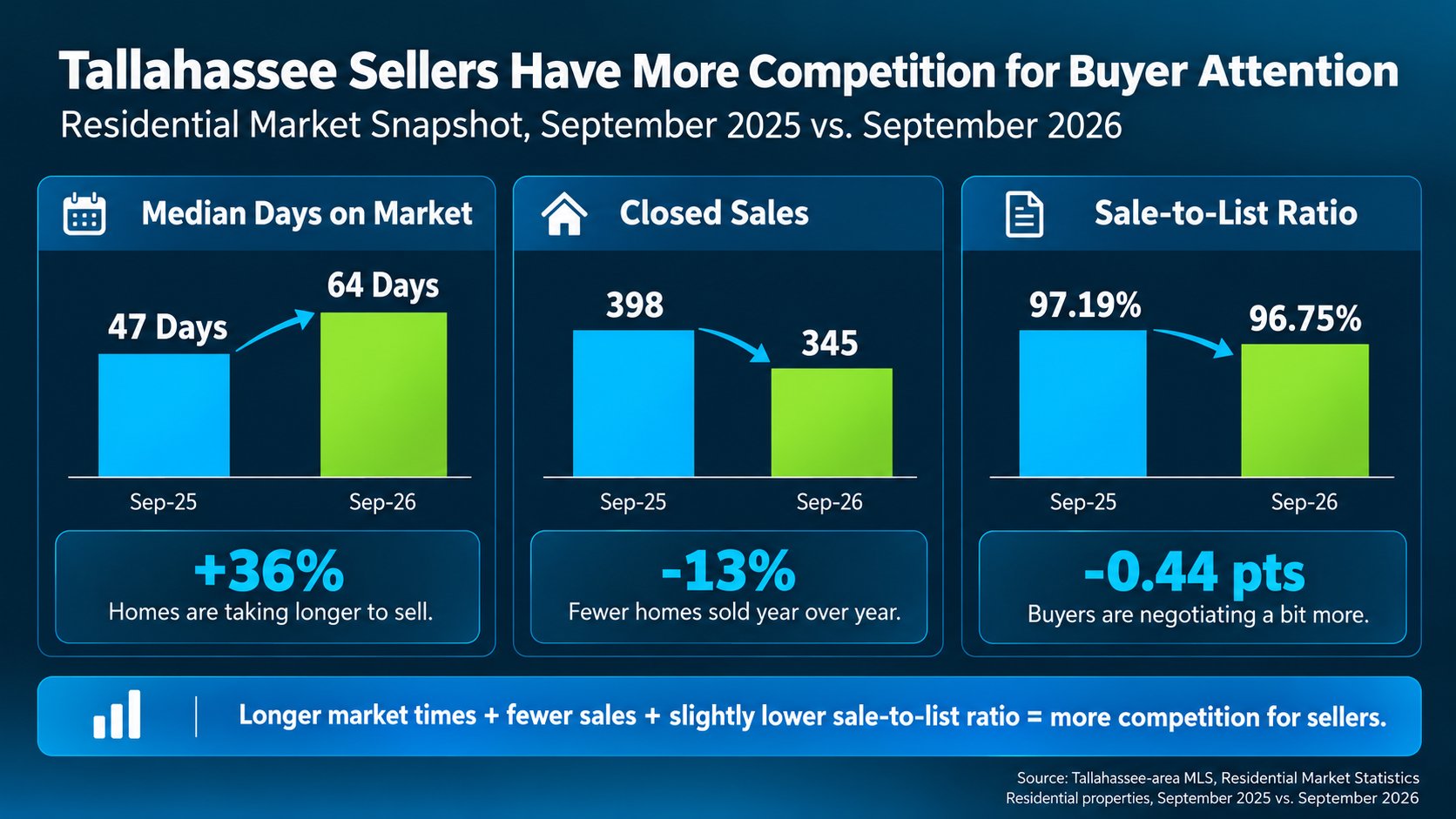
Median days on market increased from 47 days in September 2025 to 64 days in September 2026, while closed residential sales fell from 398 to 345.
And homes sold for an average of 96.75% of their asking price, compared with 97.19% a year earlier.
For sellers, that suggests buyers have become more selective.
And when buyers have more time to compare their options, builder incentives can become part of that comparison.
One important misconception is that mortgage-rate assistance is available only from builders.
It isn't.
Depending on the buyer's mortgage program and the structure of the transaction, an existing-home seller may be able to contribute toward certain buyer closing costs, discount points or an interest-rate buydown.
For conventional loans that meet Fannie Mae guidelines, seller and other interested-party contributions may be used toward allowable closing costs and rate buydowns, subject to contribution limits based partly on the loan-to-value ratio.
VA financing also permits sellers to pay certain closing costs and fund temporary mortgage-rate buydowns, subject to applicable VA requirements.
That doesn't mean every seller should immediately offer a rate buydown.
It means it's another tool worth understanding.
A seller and listing agent can work with the buyer's lender to determine whether money spent toward an allowable financing concession could be more meaningful to that particular buyer than the same amount spent somewhere else in the transaction.
Imagine your home has been on the market for several weeks and buyers are telling you the monthly payment feels high.
Your first instinct may be to reduce the asking price again.
That may be the right move.
But it isn't automatically the only option.
Depending on the offer and the buyer's financing, a seller contribution toward allowable closing costs or a mortgage-rate buydown may address the buyer's actual problem more directly.
That's why sellers should evaluate an offer based on more than one number.
The questions become:
What is the buyer trying to solve?
Is it the purchase price?
The monthly payment?
The amount of cash needed at closing?
The cost of repairs?
Or some combination?
A good negotiation identifies the obstacle and then determines which term can solve it most efficiently.
Large builders have an advantage individual homeowners generally don't.
They're selling multiple houses.
That volume can give them relationships with lenders and the ability to spread the cost of incentives across many transactions. HousingWire notes that rate buydowns have been one reason new-home sales have held up better than existing-home sales during the higher-rate environment.
An individual seller shouldn't necessarily try to replicate every promotion a national builder can advertise.
Instead, focus on the advantages your home has that new construction may not.
Price and mortgage rate are important, but they're not the only things buyers purchase.
They're buying a location and a lifestyle too.
An existing home may offer:
Those advantages need to be obvious in the marketing.
This is especially important because Realtor.com Senior Economist Joel Berner notes that resale sellers facing new-construction competition should emphasize the amenities and location advantages of established neighborhoods.
For sellers, that might mean the marketing needs to communicate much more than bedrooms, bathrooms and square footage.
Why does someone want to live here instead of in the new subdivision they're also considering?
That's the question the listing should answer.
None of this replaces appropriate pricing.
Builders aren't relying solely on financing promotions either.
Locally, some Tallahassee new-construction properties have also received price reductions. For example, current D.R. Horton inventory shows individual homes with documented reductions alongside special-rate promotions.
Nationally, builders have also been using price reductions as affordability pressure continues.
That's important for resale sellers because buyers don't separate those markets neatly.
If a new home similar to yours gets cheaper, offers a special mortgage rate, or does both, it can affect what a buyer thinks represents good value.
Your pricing strategy therefore needs to consider current active competition, not just what another house sold for six months ago.
If you're preparing to sell, one of the most useful exercises may be to look at your home the way a buyer will.
Ask:
What new-construction homes can someone buy near my price?
Are any builders offering special financing or closing-cost incentives?
How does my home's monthly-payment scenario compare?
What does my home offer that the new build doesn't?
Is my location better for this particular buyer?
Does my home have improvements the buyer would have to pay to add to a new house?
Would a concession make my property more competitive without unnecessarily reducing the price?
Those answers can influence how the home is priced, marketed and negotiated.
Builder incentives can be attractive, but buyers should still compare the full financial picture.
A promotional mortgage rate doesn't necessarily mean one property is less expensive overall.
Compare:
And if a builder requires the use of a preferred lender to receive an incentive, compare that Loan Estimate with other financing options before deciding.
The best deal isn't necessarily the house with the lowest advertised mortgage rate.
It's the one that makes the most sense when all of the numbers and tradeoffs are considered together.
Builder competition also won't affect every seller equally.
A homeowner selling in a neighborhood or price range with significant new construction may need to pay very close attention to builder incentives.
Another seller may have very little direct new-construction competition.
Property type matters too.
So do location, school zones, lot size, condition and price range.
That's why a national statistic saying 18.8% of new-construction listings offer incentives is useful context, but it isn't a Tallahassee statistic and shouldn't be treated as one.
What matters to a local seller is:
What are the homes competing with mine offering right now?
Higher mortgage rates are making buyers more conscious of affordability, and builders are responding.
Nationally, nearly 1 in 5 new-construction listings advertised an incentive, with reduced mortgage rates by far the most common promotion.
And Tallahassee isn't immune. Some local builders are currently advertising special interest-rate opportunities on select homes.
For sellers, that doesn't mean you need to panic, slash your price or automatically offer a huge concession.
It means you need to know your competition.
Price the home for today's market. Market the advantages a new build can't replicate. And when an offer comes in, be willing to look at the complete deal rather than focusing on price alone.
Because in today's market, selling successfully isn't necessarily about offering the biggest incentive.
It's about figuring out what matters most to the buyer and positioning your home accordingly.
Stay up to date on the latest real estate trends.

All Real Estate News
November 10, 2026

All Real Estate News
November 10, 2026

Local Events
November 7, 2026

Local Events
November 6, 2026
All Real Estate News
November 4, 2026

All Real Estate News
November 3, 2026
You’ve got questions and we can’t wait to answer them.