
If your home has been sitting on the market without much interest, you might be considering a price reduction.
You're certainly not alone.
According to Altos Research data, 310 Tallahassee-area homes experienced price reductions in October 2026, compared with 258 during October 2025. That's an increase of approximately 20% in just one year.
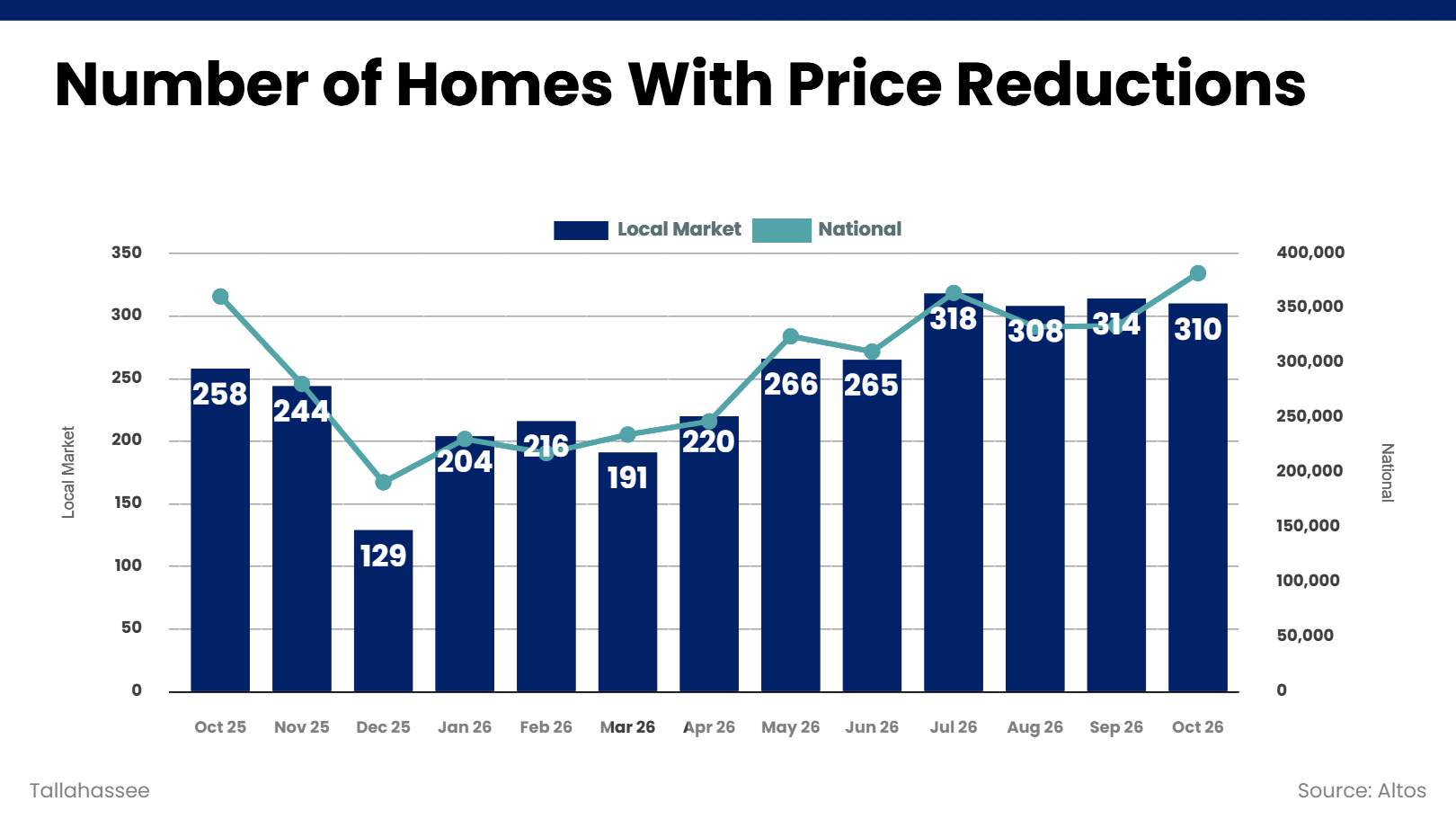
And nationally, the trend is even more noticeable. HousingWire Data indicates that approximately 43% of active single-family listings have experienced a price reduction.
But here's a question worth asking before dropping your asking price:
What if you could make your home more affordable to prospective buyers without actually lowering the price?
For some sellers, a mortgage rate buydown may be worth considering. Depending on the financing and terms of the offer, it could make a bigger difference in the buyer's monthly payment than a traditional price reduction.
Let's look at how it works, what the numbers mean, and when each strategy makes the most sense.
Price Cuts in Tallahassee
Price reductions have become a familiar part of today's housing market, and Tallahassee is no exception.
According to Altos Research, the number of local homes with price reductions has fluctuated throughout 2026.
In January, 204 homes experienced price reductions. By July, that number had climbed to 318. August and September recorded 308 and 314, respectively, followed by 310 in October.
While October's figure is slightly lower than September's, it's still approximately 20% higher than the same month last year.
Of course, a price reduction doesn't automatically mean a seller is desperate, or that property values are declining across the board.
Sometimes a home was simply priced too aggressively. Other times, changing competition, property condition, or limited buyer activity can lead a seller to adjust their expectations.
And pricing is especially important when prospective buyers have alternatives.
According to Redfin, there were approximately 63% more home sellers than buyers nationally in September 2026. That's the largest imbalance in its records dating back to 2013.
While that national statistic doesn't necessarily describe Tallahassee's exact market conditions, our local numbers also suggest that pricing and negotiation matter.
Florida Realtors' September 2026 SunStats report showed that single-family sellers in the Tallahassee MSA received a median of 97% of their original asking price, compared with 97.7% one year earlier.
And with fewer closed sales compared with September 2025, sellers have good reason to consider how their property compares with the competition.
But reducing the asking price isn't always the only way to attract an offer.
Why Buyers Are Asking for More
It's no secret that housing affordability has become a significant consideration for prospective homebuyers.
Higher mortgage rates, property taxes, homeowners insurance, and other expenses all influence what someone can comfortably afford.
And when buyers compare homes, they aren't just looking at the asking price.
They're also considering what that property will cost them every month.
That's an important distinction for sellers.
A $10,000 price reduction might sound substantial, but when that difference is spread across a 30-year mortgage, the monthly savings may be relatively modest.
A mortgage rate buydown, on the other hand, may provide more noticeable payment relief, particularly during the early years of the loan.
What Is a Mortgage Rate Buydown?
A mortgage rate buydown is a financing arrangement in which money is paid upfront to reduce the interest rate or subsidize a portion of the borrower's mortgage payments.
The funds may come from the seller, lender, or buyer, depending on the arrangement.
When a seller contributes toward a buydown, the goal is generally to improve the property's affordability without necessarily reducing the agreed-upon purchase price.
There are two common approaches.
Temporary Rate Buydowns
A temporary buydown reduces the borrower's effective monthly principal and interest payment for a specified period.
One common example is a 2-1 buydown.
If the mortgage has a 7% fixed note rate, the payments under a 2-1 buydown are calculated as though the rate were:
- 5% during the first year.
- 6% during the second year.
- 7% beginning in the third year.
The underlying contractual interest rate remains 7%. The upfront buydown funds subsidize the difference during the first two years.
This can make the initial payments more manageable, particularly when buyers anticipate future income increases or want additional flexibility during their first years of homeownership.
However, borrowers generally must qualify based on the full note rate, not the temporarily reduced payment.
And while refinancing might eventually be an option, it isn't guaranteed.
Permanent Rate Buydowns
A permanent buydown works differently.
Instead of temporarily subsidizing payments, funds are used to purchase discount points that lower the mortgage's contractual interest rate for the loan term.
One discount point typically costs 1% of the mortgage amount, although the actual interest rate reduction varies by lender, loan program, and market conditions.
Permanent buydowns may be particularly attractive to buyers who expect to keep their mortgage for an extended period.
Neither approach is automatically better. The right option depends on the loan terms, available funds, and the buyer's financial priorities.
A Local Payment Comparison: $10,000 Price Cut vs. Rate Buydown
Let's put this into perspective using Tallahassee's September 2026 median single-family sale price of $329,950.
For this illustration, assume the buyer is financing the purchase with a 30-year fixed mortgage at 7%, putting 20% down, and the seller is willing to negotiate approximately $10,000 in concessions.
What difference could that money make?
Comparison | $10,000 Price Reduction | Seller-Funded 2-1 Buydown |
|---|---|---|
Purchase Price | $319,950 | $329,950 |
Loan Amount | $255,960 | $263,960 |
Year 1 Monthly Payment | $1,703 | $1,417 |
Year 2 Monthly Payment | $1,703 | $1,583 |
Year 3 Onward | $1,703 | $1,756 |
This example is principal and interest payments only, assumes 20% down, a 30-year fixed loan, and a 7% note rate. Taxes, insurance, HOA fees, closing expenses, and other costs are excluded.
Under these assumptions, the $10,000 price reduction lowers the monthly principal and interest payment by approximately $53 compared with purchasing the home at its original price.
But a 2-1 buydown could reduce that payment by approximately $339 per month during the first year and $174 per month during the second year.
That's a substantially larger difference in the short term.
The estimated cost of funding that 2-1 buydown would be approximately $6,150. If the seller were willing to contribute a total of $10,000, the remaining approximately $3,850 might also be available toward eligible closing costs, subject to the loan program, actual costs, and lender approval.
Of course, the two arrangements aren't identical.
A price reduction lowers the purchase price, required down payment, and financed balance. Its principal and interest savings continue throughout the mortgage term.
A temporary buydown offers larger initial payment relief, but once the subsidy expires, the full payment applies.
And the seller's actual net proceeds may differ depending on the negotiated terms and transaction expenses.
The important takeaway isn't that a rate buydown is always better. It's that the same negotiation budget can produce very different results.
When a Price Reduction Is Better
Despite the potential benefits of a mortgage rate buydown, there are situations where lowering the asking price may be the more effective strategy.
For example, if a property is priced substantially above comparable sales, offering a rate buydown probably won't solve the underlying problem.
Buyers and their agents still evaluate market value, and lenders generally require appraisals to support the transaction.
A lower asking price may also make a property visible to additional prospective buyers searching within specific price ranges.
Consider a home listed at $410,000.
If many buyers are searching for properties priced at $400,000 or less, reducing the price to $399,900 could make that home appear in searches where it wasn't previously visible.
A seller-funded rate buydown wouldn't necessarily accomplish that.
Price reductions may also be more attractive to cash buyers, who wouldn't benefit from mortgage interest savings.
And some buyers simply prefer a lower purchase price, reduced debt, or a smaller down payment over temporary payment assistance.
That's why the strategy should start with understanding why a property isn't attracting offers.
If the asking price doesn't reflect the market, a buydown isn't necessarily the answer.
What Sellers Should Know Before Offering a Buydown
Before offering a mortgage rate buydown, there are a few important things to understand.
Loan programs limit seller contributions. Conventional, FHA, VA, USDA, and other loan programs have different requirements governing seller concessions. The amount permitted can depend on the loan type, occupancy, down payment, and other factors.
Not every buyer can use every buydown program. Eligibility depends on the lender and mortgage product. Any proposed arrangement should be reviewed with the buyer's lender before being included in an executed agreement.
Temporary payment relief isn't the same as permanent affordability. Buyers generally need to qualify for the full contractual payment even when the initial payments are subsidized.
Other concessions still matter. A buyer may request repairs, closing cost assistance, or other terms. Those expenses should be evaluated together, and applicable lender limits may apply to combined seller contributions.
The costs should be compared before negotiating. Sellers can work with their real estate professional and an appropriately licensed mortgage lender to evaluate illustrative financing scenarios and estimated net proceeds.
A buydown can also be presented as a potential option in listing marketing, provided the terms are accurate, permitted by applicable advertising and MLS rules, and subject to lender approval.
The goal is to offer a meaningful benefit without creating unrealistic expectations.
Choosing the Right Strategy for Your Tallahassee Home
Every property competes within its own market.
A home in Killearn Estates may face different competition than a newer property in Canopy or a condominium in downtown Tallahassee.
Price range, condition, location, inventory, and financing options can all influence what buyers value most.
That's why a one-size-fits-all approach to price reductions and seller concessions doesn't always make sense.
For some properties, correcting the asking price may be the most effective way to generate additional interest.
For others, especially homes already priced competitively, offering assistance with financing costs could help distinguish the property from similar listings.
And sometimes the best strategy involves a combination of adjustments.
A successful home sale starts with accurate market analysis, thoughtful pricing, effective marketing, and a clear understanding of the property's competition.
The objective isn't simply to offer the biggest concession.
It's to identify the strategy that makes the most sense for the seller's goals while giving qualified buyers a compelling reason to consider the property.
The Bottom Line
With 310 Tallahassee homes recording price reductions in October 2026, sellers have good reason to examine their pricing and negotiating strategies.
But reducing the asking price isn't the only option.
A seller-funded mortgage rate buydown could provide more substantial monthly payment savings for some buyers, especially during the early years of their mortgage.
However, a price reduction may still be the better choice when a property is priced above the competition or when a lower purchase price provides greater value.
Ultimately, the best concession isn't necessarily the one that sounds the biggest. It's the one that helps accomplish the seller's goals and makes financial sense for the transaction.
Sources: Altos Research, Tallahassee price reduction data through October 2026; Florida Realtors SunStats, Tallahassee MSA single-family homes, September 2026; HousingWire Data; Redfin, September 2026; Consumer Financial Protection Bureau; and Fannie Mae Selling Guide. All financing examples are illustrative, not loan offers or guarantees.