Help! My Home Didn’t Get an Offer. Now What?
September 7, 2026
All Real Estate News

September 7, 2026
All Real Estate News
Whether your home has been on the market for three days, a week, a month, or a few months, there usually comes a point when sellers start asking the same uncomfortable question:
Why haven’t we gotten an offer?
And whenever you reach that point, it is a fair question to ask.
Maybe you expected something during the first weekend. Maybe you have had plenty of showings but nobody has taken the next step. Maybe you have watched another house down the street go under contract while yours is still sitting there looking perfectly innocent on Zillow.
Whatever the timeline, if you are starting to worry about it, that matters.
The good news is that not getting an offer does not automatically mean something is seriously wrong with your home.
But it does mean the market is giving you information.
The goal now is to figure out what that information is telling you.
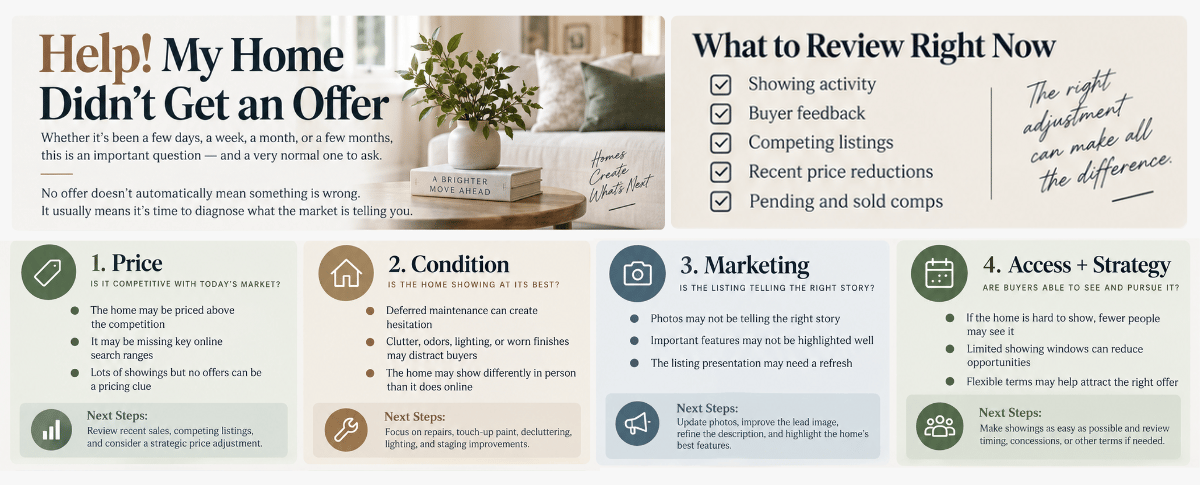
In most cases, the answer falls into one or more of four categories:
Once you identify which category is holding things back, deciding what to do next becomes much easier.
There is no universal deadline.
A home that has been listed for four days is in a very different situation from one that has been listed for four months.
The price point matters. The neighborhood matters. The condition matters. The number of competing homes matters.
And the Tallahassee market today is not the market we experienced a few years ago when some homes seemed to receive five offers before everyone finished breakfast.
In July 2026, the median Tallahassee residential property took about 23 days to go under contract, according to Florida Realtors®.
That means a home not receiving an offer during its first weekend is not automatically a problem.
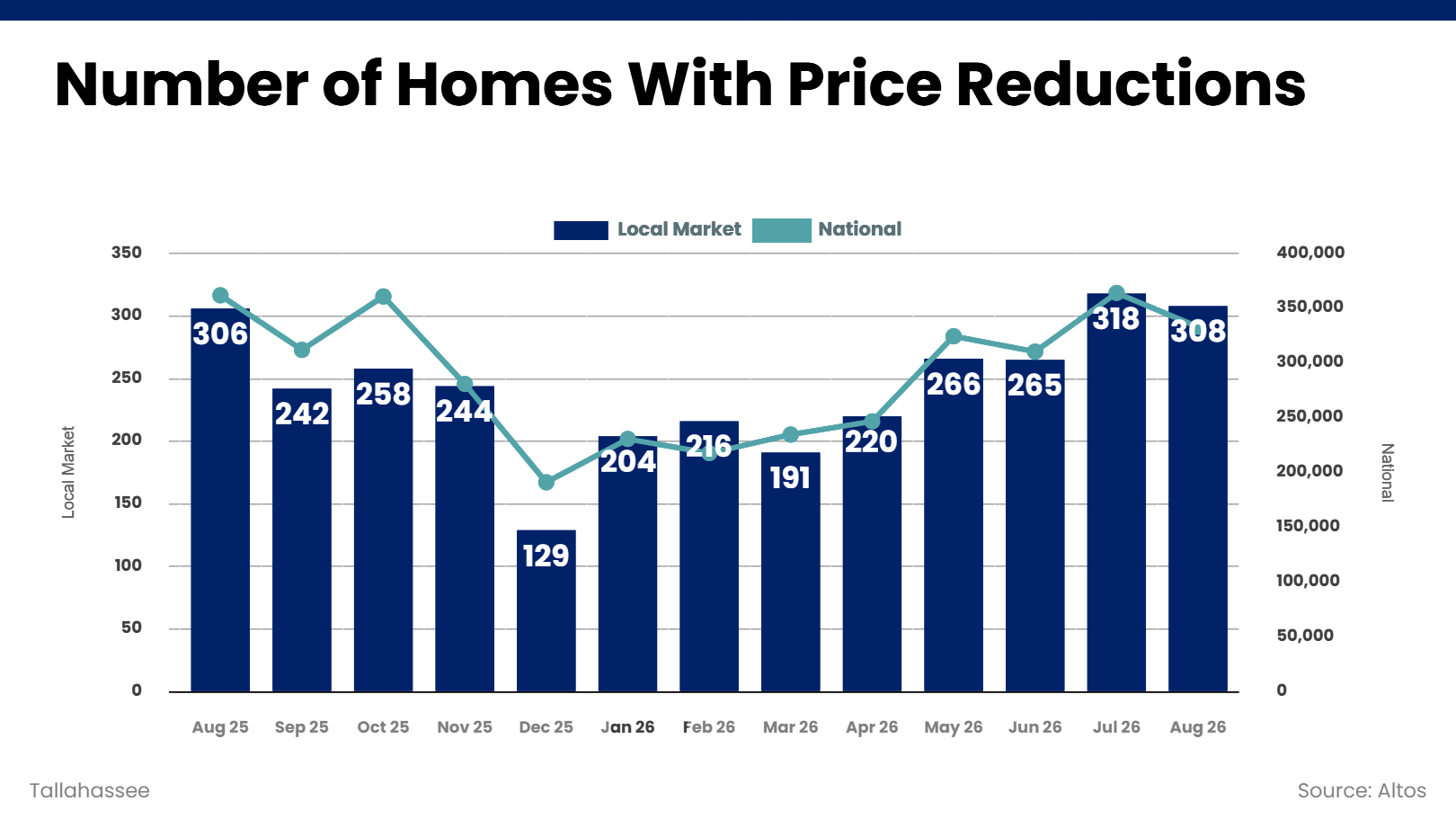
At the same time, price reductions have become increasingly common. Altos recorded 308 Tallahassee homes with price reductions in August, compared with 191 in March, and 129 in December.
So waiting forever without evaluating what is happening is not necessarily the answer either.
The better question is:
What has happened since we listed, and what does it tell us?
Before changing anything, look at the pattern.
Are you getting almost no showings?
Are people touring the home but not scheduling second visits?
Are you getting a lot of activity but no offers?
Are you seeing plenty of online views but very few appointments?
Different symptoms point toward different problems.
Think of this less like pushing the panic button and more like diagnosing the listing.
Price is one of the first things sellers tend to worry about, and sometimes it is the issue.
But pricing is not simply about deciding what your home is “worth.”
It is about where your home sits compared with everything else someone can buy.
If your home is listed at $400,000, someone shopping in that range may also be considering homes from roughly $375,000 to $425,000.
They might be comparing:
• Square footage
• Updates
• Lot size
• Age
• Location
• Roof and major systems
• Floor plan
• Condition
• Amenities
• Monthly payment
• Overall value
The question becomes:
Why should someone choose your house instead of the others?
Very few showings can be an early pricing clue.
People may simply be seeing stronger alternatives in the same price range.
On the other hand, lots of showings without an offer can also point toward price.
That often means people are interested enough to see the property, but after experiencing it in person, the value does not quite line up with the asking price.
There is also the issue of online search ranges.
Someone may set their maximum price at $400,000.
A home listed at $405,000 may never appear in that search.
Sometimes moving into a different search bracket can expose the property to an entirely new group of people.
Your original pricing analysis does not freeze in time.
New listings come on the market.
Other homes reduce their prices.
Pending sales give us new information.
Closed sales create new comparable data.
The house that looked perfectly positioned two weeks ago may suddenly be competing with a renovated home around the corner for $15,000 less.
That is why pricing should be reviewed throughout the listing period, not just before the sign goes in the yard.
Maybe.
But price reductions should be strategic.
Reducing a home by $1,000 simply so the listing can advertise a price change may not materially change the way people see it.
A meaningful adjustment should improve the home's competitive position.
The right amount depends on the home, recent comparable sales, current competition and the response the listing has received so far.
The market is already giving you data.
Use it.
Sometimes the online listing gets someone through the door, but the in-person experience stops things there.
That does not necessarily mean the home needs a major renovation.
It may mean a few things are distracting people from everything that is good about the house.
One comment from one person may not mean much.
Six people mentioning the same issue probably does.
Maybe people repeatedly say:
• The rooms feel darker than expected
• The carpet looks worn
• The landscaping feels neglected
• There is an odor
• A repair is noticeably unfinished
• The house feels cluttered
• A room is difficult to understand
• The home does not feel as updated as competing properties
Feedback is not always pleasant.
But it can be incredibly useful.
Before anyone starts swinging a sledgehammer through the kitchen, remember that relatively inexpensive changes can sometimes make a major difference.
That might include:
• Touch-up paint
• Pressure washing
• Landscaping
• Decluttering
• Rearranging furniture
• Replacing burned-out bulbs
• Improving lighting
• Repairing obvious maintenance items
• Cleaning carpets
• Addressing odors
The goal is not necessarily to make the home perfect.
It is to remove reasons someone might hesitate.
And before spending significant money on improvements, talk through whether those changes are actually likely to improve the sale.
Not every renovation pays you back.
People usually meet your house online before they meet it in person.
That first impression matters.
If the home is not generating enough interest, the marketing deserves a review too.
Professional photography should make the property easy to understand and give people a reason to want to see more.
Ask:
Is the strongest photograph being used first?
Are important rooms represented well?
Does the home look bright and inviting?
Are the photos current?
Do they accurately represent the property?
Maybe the home has:
A huge backyard.
A remodeled primary bathroom.
A workshop.
A screened porch.
A newer roof.
A great floor plan.
A walkable location.
A stunning community center.
A feature that makes someone say, “Wait, it has THAT?”
If the best thing about the home is buried in photo number 27 or paragraph three of the description, the marketing may need to do a better job telling the story.
A strong listing marketing plan may include professional photography and video, drone photography and video, 3D virtual tours, 2D floor plans, individual property websites, social media marketing, and broad online exposure.
But producing marketing materials is only the beginning.
We also want to look at how people are responding to them.
Are people saving the listing?
Are they clicking through to the property website?
Are they watching the video?
Is the home reaching the people most likely to be interested in it?
Marketing should not be a “set it and forget it” activity. It should be tracked and adjusted if something is not working.
Sometimes the house is competitively priced.
It shows well.
The marketing looks great.
And there is still another obstacle.
People need a realistic opportunity to see the property and pursue it.
Living in a listed home is inconvenient.
Keeping everything clean is inconvenient.
Getting pets out of the house is inconvenient.
Loading everyone into the car because someone wants to come by in 45 minutes is definitely inconvenient.
But restrictive showing schedules can reduce opportunities.
If someone is visiting Tallahassee for one afternoon and cannot see the home during that window, they may simply move on to another property.
People cannot fall in love with a house they cannot get into.
That does not mean sellers should abandon reasonable boundaries.
It means making the home as accessible as reasonably possible.
Sometimes price is not the only lever available.
Depending on the situation, sellers may choose to consider things like:
• Closing cost assistance
• Repair credits
• Closing dates
• Possession timing
• Financing-related concessions
• Other negotiated terms
For some purchasers, a concession that reduces cash needed at closing or affects financing costs may matter more than an equivalent reduction in purchase price.
Every transaction is different, so financing-related strategies should be reviewed with the appropriate real estate and lending professionals.
The point is simply this:
Sometimes the answer is not “lower the price.”
Sometimes the answer is “make the deal easier to put together.”
If you are wondering why your home has not received an offer, start with evidence instead of emotion.
Review:
• Online views and saves where available
• Showing activity
• Showing feedback
• Open house traffic
• Current competing listings
• Recent price reductions
• Homes that recently went under contract
• Newly closed comparable sales
• Your position within common online price searches
• Repeated condition concerns
• Showing availability
• Terms that may help improve the home's competitive position
Then ask:
What is keeping someone from choosing this house?
The answer will usually point toward one of the four categories.
Price.
Condition.
Marketing.
Access + Strategy.
And sometimes it is a little bit of more than one category.
Do not panic because the first weekend passed without an offer.
Do not ignore several weeks of poor activity either.
Do not assume price is the problem before reviewing everything else.
Do not dismiss repeated showing feedback simply because you disagree with it.
Do not renovate half the house without deciding whether those improvements are actually likely to help.
And do not keep doing exactly the same thing for months while hoping the market suddenly changes its mind.
The listing is giving you information.
Use it.
A home that does not immediately receive an offer is not automatically a bad house, a failed listing, or a lost cause.
Some homes sell in a weekend.
Some take a few weeks.
Some take longer.
Every property has its own price point, competition, condition, location and potential audience.
What matters is recognizing when the market is communicating with you and knowing what to do with that information.
Sometimes the answer is patience.
Sometimes it is price.
Sometimes it is condition or presentation.
Sometimes it is better marketing.
Sometimes it is easier access or more competitive terms.
And sometimes a few small changes are enough to make the entire listing click.
Whether you have been listed for a few days, a few weeks or a few months, reaching the point where you are asking, “Why haven't we gotten an offer?” is a good reason to review the strategy.
Look at the data.
Look at the competition.
Look at the feedback.
Look at what has changed since the property first hit the market.
Then decide what the next move should be.
Because “We didn't get an offer” does not necessarily mean something went wrong.
Sometimes it means:
We learned something.
Now we adjust.
Stay up to date on the latest real estate trends.

All Real Estate News
October 23, 2026

All Real Estate News
October 23, 2026

All Real Estate News
October 21, 2026

All Real Estate News
October 20, 2026

Articles for Buyers
October 19, 2026

October 19, 2026
You’ve got questions and we can’t wait to answer them.