Mortgage Rates Are Up. But Is That Actually the Rae You'll Get?
October 6, 2026
All Real Estate News

October 6, 2026
All Real Estate News
Mortgage rates have climbed again, and if you're thinking about buying a home, the headlines may be enough to make you want to put your home search on hold.
As of October 1, 2026, Freddie Mac reported that the average rate for a 30-year fixed mortgage had risen to 7.28%, up from 7.03% just one week earlier.
That's certainly worth paying attention to.
But there's something equally important to understand:
7.28% isn't necessarily the mortgage rate you'd get.
It's a national average based on mortgage applications submitted through participating lenders. Your actual rate depends on your finances, the loan you're considering, the property you're buying, the lender you choose and even when you lock the rate.
So before a headline convinces you that buying a home is suddenly off the table, it's worth finding out what your numbers actually look like.
Mortgage rates aren't one-size-fits-all.
Two people could make offers on similarly priced homes on the same day and receive different mortgage rates.
That's because lenders consider a number of factors when pricing a loan. Fannie Mae notes that a borrower's specific rate can be affected by factors including credit score, property location, purchase price, loan amount, loan term and loan type. Rates can also vary from one lender to another.
Some of the biggest factors include:
Credit matters because it gives lenders information about how you've handled borrowed money in the past.
A higher credit score can generally help a borrower qualify for more favorable mortgage pricing, although your score is only one piece of the lender's evaluation.
Your credit report can reflect things like payment history, outstanding balances and recent applications for credit.
That also makes the months before buying a home a particularly important time to be careful about opening new credit cards, financing vehicles or taking on other debt.
Your debt-to-income ratio, commonly called DTI, compares your monthly debt obligations with your monthly income.
That can include debts such as car payments, student loans, credit cards and other recurring obligations.
Your DTI can affect both how much you're able to borrow and which mortgage options may be available to you.
Your down payment determines how much of the purchase price you're paying upfront and how much you'll need to finance.
That creates what's known as your loan-to-value ratio, or LTV.
A larger down payment generally means borrowing less, and Fannie Mae notes that the amount you put down may affect your loan options, interest rate and whether mortgage insurance is required.
That does not mean putting 20% down is always the best choice or even necessary.
The right down payment depends on your finances, the loan program and how much cash you want to keep available after closing.
A conventional mortgage, FHA loan, VA loan and other mortgage programs don't necessarily carry identical rates or costs.
The length of the loan matters too.
A lender can help compare the combinations available to you rather than assuming the rate attached to one particular loan product is the only option.
Your financing isn't the only thing that can affect how affordable a purchase becomes.
The property and the deal you negotiate matter too.
That's particularly relevant in Tallahassee right now.
Tallahassee-area MLS data for September 2026 shows residential properties had a median 64 days on market, compared with 47 days in September 2025.
Homes also sold for an average of 96.75% of their asking price.
That doesn't mean every Tallahassee seller is ready to negotiate. A well-priced home in a desirable location can still attract plenty of interest.
But when a home has been available for several weeks, the conversation may look different.
That can create opportunities to negotiate not only the purchase price, but potentially other terms that affect how much cash you'll need or what your monthly payment looks like.
One option worth discussing with your lender and real estate agent is a seller concession.
Depending on the loan program and transaction, a seller may be able to contribute toward certain buyer closing costs.
Instead of negotiating another few thousand dollars off the purchase price, for example, a buyer may decide that having the seller contribute toward allowable closing costs is more valuable.
Why?
Because reducing the cash needed at closing may allow the buyer to preserve savings, adjust the amount they're putting down or use available funds differently.
Conventional loan guidelines allow qualifying seller contributions toward borrower closing costs and prepaid expenses, with limits depending on factors such as occupancy and loan-to-value ratio. VA loans also permit sellers or builders to cover eligible closing costs, subject to program rules.
The key is to structure the offer with your lender involved so you know what's permitted under your particular loan.
Another strategy you may hear about is a mortgage rate buydown.
A buydown involves paying an upfront cost in exchange for a lower mortgage rate.
Depending on the transaction and loan program, those costs may sometimes be paid by the buyer, seller, builder or another permitted party.
There are different types of buydowns, so don't assume every advertised builder or seller incentive works the same way.
Ask the lender to show you:
That's a much better comparison than simply seeing a lower advertised rate and assuming it's automatically the better deal.
The only way to answer that question with any confidence is to talk with a lender.
And you don't necessarily need to wait until you've found the house.
In fact, talking with a lender before seriously shopping can help you understand what price range makes sense and what changes, if any, could improve your financing options.
A lender may discuss either pre-qualification, pre-approval or both.
The terminology can be confusing because lenders don't all use those terms in exactly the same way.
The Consumer Financial Protection Bureau specifically notes that some lenders use “prequalification” for an evaluation based largely on information you provide, while others use “preapproval” for a process involving more verification. The processes and terminology vary by lender.
Generally, the more thoroughly your finances have been reviewed, the clearer the picture you'll have of what you may actually be able to finance.
And one important point:
A pre-approval isn't the same thing as a guaranteed mortgage or a locked interest rate.
Your final loan remains subject to the lender's requirements, the property, your financial circumstances and the terms available when you move forward.
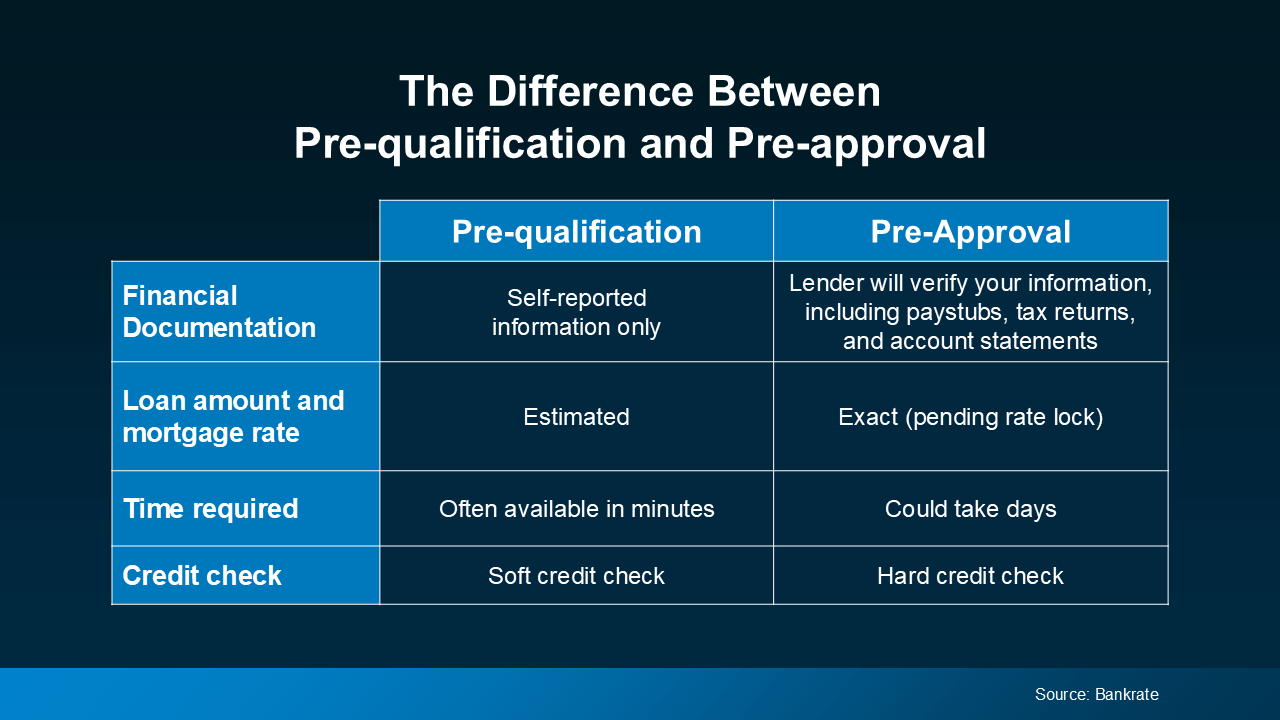
Please note: Because individual lenders use the terms pre-qualification and pre-approval differently, borrowers should ask their lender exactly what information is being verified and whether a credit inquiry is required.
Not as much as many buyers think.
Mortgage lenders commonly review credit as part of evaluating a borrower. But federal consumer guidance specifically encourages borrowers to compare lenders.
The CFPB recommends contacting multiple lenders and says consumers can shop around for mortgage financing without being afraid that every mortgage inquiry will independently wreck their credit score. Multiple mortgage credit checks made within a typical rate-shopping window are generally treated as a single inquiry for scoring purposes.
That's important because your lender matters.
The CFPB recommends comparing at least three mortgage offers, and Fannie Mae also notes that mortgage rates can vary from lender to lender.
In other words, shopping for the house is only half the job.
Shop the mortgage too.
Don't make the conversation only about today's interest rate.
Try asking:
What rate and APR would I likely qualify for based on my current finances?
APR incorporates certain loan costs in addition to the interest rate, which can make it useful when you're comparing financing.
What could I realistically afford without stretching my monthly budget?
A lender may tell you how much you can borrow. That doesn't necessarily mean that's how much you should spend.
Would changing my down payment affect my rate, mortgage insurance or overall monthly payment?
Sometimes preserving cash can make more sense. Sometimes putting additional money down produces a meaningful benefit. Ask for both scenarios.
Are there loan programs I should compare?
Conventional financing may not be the only option available.
Would paying points or using a seller-funded buydown make sense?
Ask for the actual numbers rather than assuming a lower rate automatically means a better deal.
How would seller-paid closing costs affect my particular loan?
This can be especially useful when evaluating Tallahassee properties where the seller may have more flexibility.
What would need to change for me to qualify for a better rate?
Sometimes improving a credit score, reducing a debt balance or changing the loan structure can make a measurable difference.
And then ask one of the most useful questions of all:
What happens financially if I buy now compared with waiting 3, 6 or 12 months?
Nobody can guarantee where mortgage rates or Tallahassee home prices will be months from now.
But your lender can show you scenarios based on today's numbers so you're making a decision instead of making a guess.
As of October 3, 2026, the Tallahassee-area MLS showed 1,806 active residential listings.
The median asking price among those active residential properties was $319,950, and their median time on market was 59 days.
That means Tallahassee buyers aren't making financing decisions in a vacuum.
The mortgage rate matters.
But so do:
That's why looking only at a national mortgage-rate headline can give you an incomplete picture of what buying a Tallahassee home would actually cost.
Mortgage rates are high again. Freddie Mac's national average for a 30-year fixed mortgage reached 7.28% on October 1, 2026.
But that number isn't automatically your number.
Your actual mortgage rate and overall cost of borrowing depend on your credit, down payment, debt, loan type, loan term, lender and other details specific to your purchase.
And in today's market, the terms you negotiate on the home itself may matter too.
So if a mortgage-rate headline has convinced you that buying isn't possible, don't make the decision from the headline alone.
Talk with a lender. Find out what you actually qualify for. Compare your options. Then decide whether buying now or waiting makes the most sense for your finances.
Because the most important mortgage rate isn't the one making the news.
It's the one you can actually get.
Stay up to date on the latest real estate trends.
All Real Estate News
October 6, 2026

All Real Estate News
October 5, 2026

All Real Estate News
October 5, 2026

All Real Estate News
October 2, 2026

All Real Estate News
October 1, 2026

All Real Estate News
September 30, 2026
You’ve got questions and we can’t wait to answer them.