Why Home Sales Fall Through and What Sellers Can Do About It
August 31, 2026
All Real Estate News

August 31, 2026
All Real Estate News
Getting your home under contract feels like a huge milestone. The photos are done. The showings are over, hopefully. You accepted an offer. You may even be mentally arranging furniture in wherever you are headed next.
So, naturally, one of the last things any seller wants to think about is the deal falling apart before closing.
The good news is that most do not.
According to the latest Redfin data, nationally, 14% of U.S. home-sale agreements fell through in July 2026. Put another way, about 86% stayed together.
Still, the reasons transactions fall apart nationally are worth paying attention to here because one issue towers over the others, and it is something sellers may be able to prepare for before the house ever hits the market.
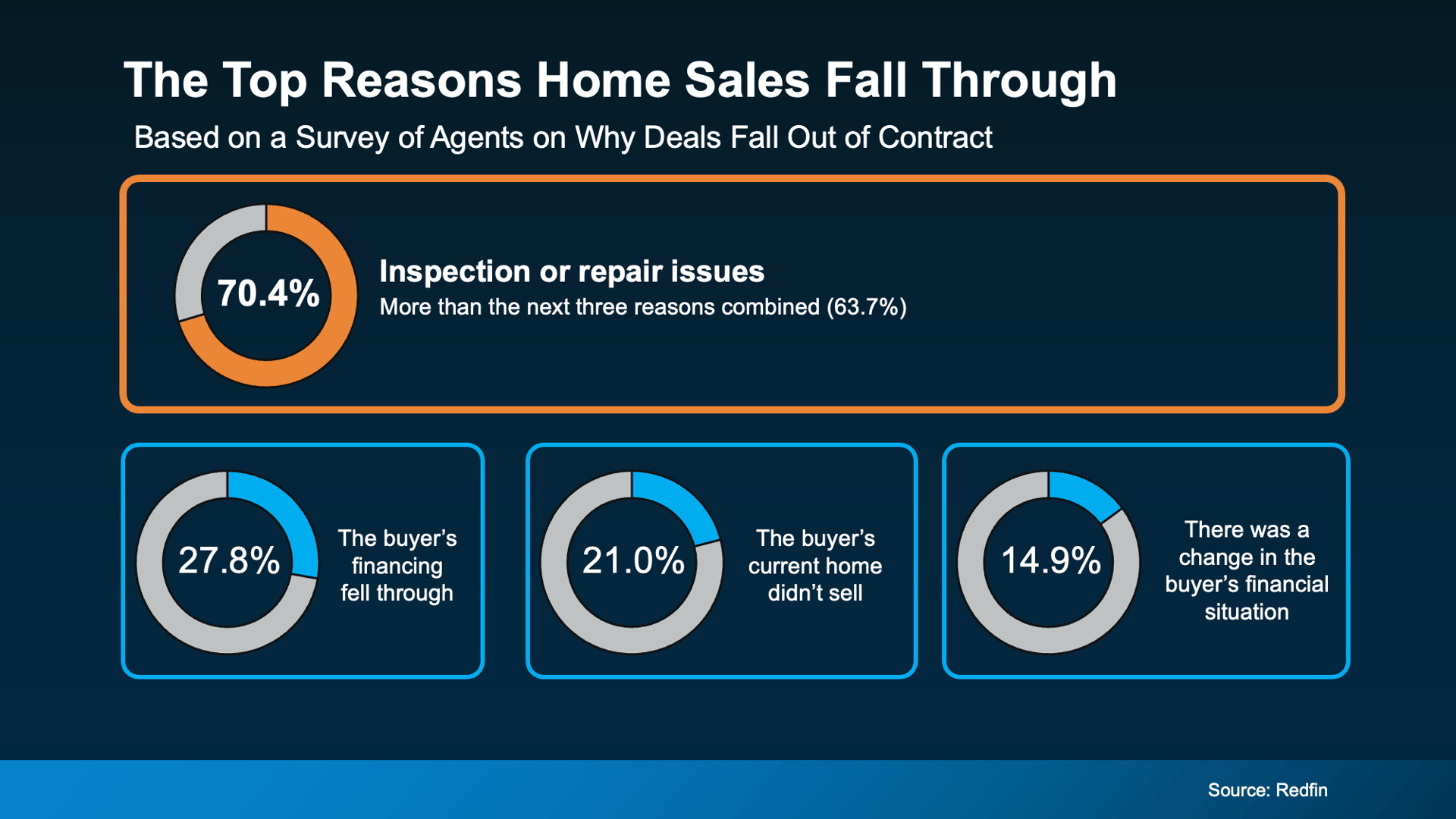
Redfin surveyed 443 of its real estate agents who had handled canceled transactions. Agents could identify the reasons they had encountered, and inspection and repair issues came up far more often than anything else:
That does not mean inspections caused 70.4% of all canceled home sales. It means 70.4% of the Redfin agents surveyed who had dealt with cancellations said inspection or repair issues were among the reasons they had encountered.
Either way, it is a pretty strong signal that the condition of a home can make a big difference between getting under contract and actually getting to the closing table.
Tallahassee sellers are operating in a market where shoppers generally have more choices than they did during the frenzy of a few years ago.
The Tallahassee metro had 1,405 active listings in July 2026, up from 1,353 in June, according to Realtor.com data published through the Federal Reserve. The median days on market was 56 days in July.
That does not automatically make every Tallahassee neighborhood, property type, or price range a buyer’s market. Real estate here can look very different depending on whether we are talking about a renovated Levy Park bungalow, a Killearn Estates home, newer construction in Canopy, or a condo in College Town.
But more choices can change the way a buyer reacts when an inspection uncovers a significant problem.
If there are several other homes that could work, sellers may have less room to assume someone will simply overlook a major roof issue, aging HVAC system, plumbing concern, electrical problem, moisture intrusion, structural question, or other expensive surprise.
And Tallahassee properties can come with some particularly varied inspection situations. An older home in an established neighborhood may have very different systems and maintenance history than newer construction. Homes farther outside the city may add wells, septic systems, acreage, drainage, outbuildings, or other components to the due diligence process.
That is why preparation before listing can matter so much.
Once a home goes under contract, the purchaser may have an opportunity to inspect the property depending on the terms of the purchase agreement.
What happens after that inspection also depends on the contract.
An inspection does not automatically mean a seller has to repair everything an inspector notes. Depending on the agreement, the purchaser may request repairs, ask for a credit or other concession, renegotiate certain terms, accept the property as-is, or potentially have a contractual right to terminate.
That is one reason it is so important to understand the actual terms of an offer before accepting it. The inspection period, repair provisions, financing, appraisal terms and other contingencies can all affect how much certainty the seller really has once the property goes under contract.
Sometimes.
A pre-listing inspection can give a seller an early look at issues that may eventually appear in the purchaser’s inspection. Zillow notes that a pre-inspection can provide a head start on identifying what may need attention before a home is listed.
That gives the seller options.
Maybe it makes sense to repair something before going to market. Maybe it makes more sense to get estimates so there is real information available if the issue comes up during negotiations. Maybe the condition should simply be taken into account when pricing the property.
And sometimes a pre-listing inspection may not be the best strategy at all.
Learning more about your property can also mean learning about a condition you did not previously know existed.
Under Florida law, when a seller knows of facts that materially affect the value of a property, are not readily observable, and are not known to the purchaser, the seller has a duty to disclose those facts. That principle comes from the Florida Supreme Court's Johnson v. Davis decision.
So a pre-listing inspection should be a thoughtful decision, not an automatic box every seller needs to check.
Your real estate professional can help you think through the practical considerations surrounding the property and the transaction. When there is a question about a seller's specific legal disclosure obligations, an attorney can provide legal advice.
There is also a middle ground between doing nothing and ordering every inspection available.
Before we list a Tallahassee property, we take a critical look at the house from the perspective of the person who is about to spend several hundred thousand dollars on it.
Is there an old water stain nobody remembers anymore? Is one HVAC unit nearing the end of its expected life? Is there a repair that has been postponed for three years? A slow drain? Soft wood around an exterior door? An old electrical panel? A roof with an uncertain installation date?
Not every item needs to be repaired before selling.
But surprises tend to be much harder to negotiate than known issues.
If we identify a potential concern early, we have time to gather information, obtain quotes when appropriate, decide whether a repair makes financial sense, and determine how the condition should factor into the overall listing strategy.
That is a lot easier than trying to solve everything while an inspection deadline is ticking.
Protecting the transaction also starts before the property ever goes under contract.
Obviously, price matters. But an offer is much more than the number at the top of the page.
When reviewing offers for a seller, we also want to understand the financing, deposits, inspection terms, appraisal provisions, requested concessions, closing timeline and contingencies.
An offer that depends on the purchaser selling another property first, for example, connects your closing to an entirely separate transaction. If that property does not sell as expected, your transaction may be affected too.
That does not automatically make it a bad offer. It means that additional risk should be considered alongside the price.
The same is true with financing, inspection periods, appraisal provisions and other terms.
Sometimes a slightly lower offer with cleaner terms and stronger financing may be more attractive to a seller than the highest number on the page. Sometimes the highest offer is still clearly the strongest.
The goal is not to automatically choose one type of offer over another. It is to understand exactly what you are accepting.
No seller can eliminate every possibility of a transaction falling apart.
Financing can change. Appraisals can create problems. Circumstances can change. Another property involved in the transaction can get delayed. An inspection can uncover something nobody knew was there.
But there is quite a bit we can do to reduce surprises.
We can take a hard look at the property before listing, talk through known concerns, decide whether additional inspections make sense, gather information on potential repairs, price the home appropriately for its condition and current competition, and carefully evaluate the complete terms of every offer.
Because getting an offer is great.
Getting under contract is even better.
But getting all the way to the closing table is the actual goal.
Most homes that go under contract still make it to closing. But when transactions do fall apart, inspection and repair concerns are one of the most frequently cited reasons.
In a Tallahassee market where purchasers have more homes to choose from than they did during the peak pandemic years, sellers can benefit from knowing as much as possible about their property before negotiations begin.
You do not necessarily need to repair everything. You do not necessarily need a pre-listing inspection. And there is no way to remove every bit of uncertainty from a real estate transaction.
But fewer surprises usually make for a smoother trip from the For Sale sign to the closing table.
Stay up to date on the latest real estate trends.
Monthly Market Updates
September 21, 2026

All Real Estate News
September 21, 2026

All Real Estate News
September 18, 2026

All Real Estate News
September 17, 2026

All Real Estate News
September 16, 2026

All Real Estate News
September 15, 2026
You’ve got questions and we can’t wait to answer them.