What Is a Property Survey?
January 24, 2026
Articles for Sellers
January 24, 2026
Articles for Sellers
This article provides general information based primarily on the Tallahassee Board of REALTORS® Contract for Sale and Purchase, revised March 2026. Individual transactions may involve different contracts, amendments, addenda, or statutory requirements. This article is not legal advice. Consult a Florida real estate attorney regarding specific contractual rights or disputes.
Whether you're selling, buying, or planning improvements to a property in Tallahassee, a survey can reveal important information about the land that might not be obvious just by looking at it.
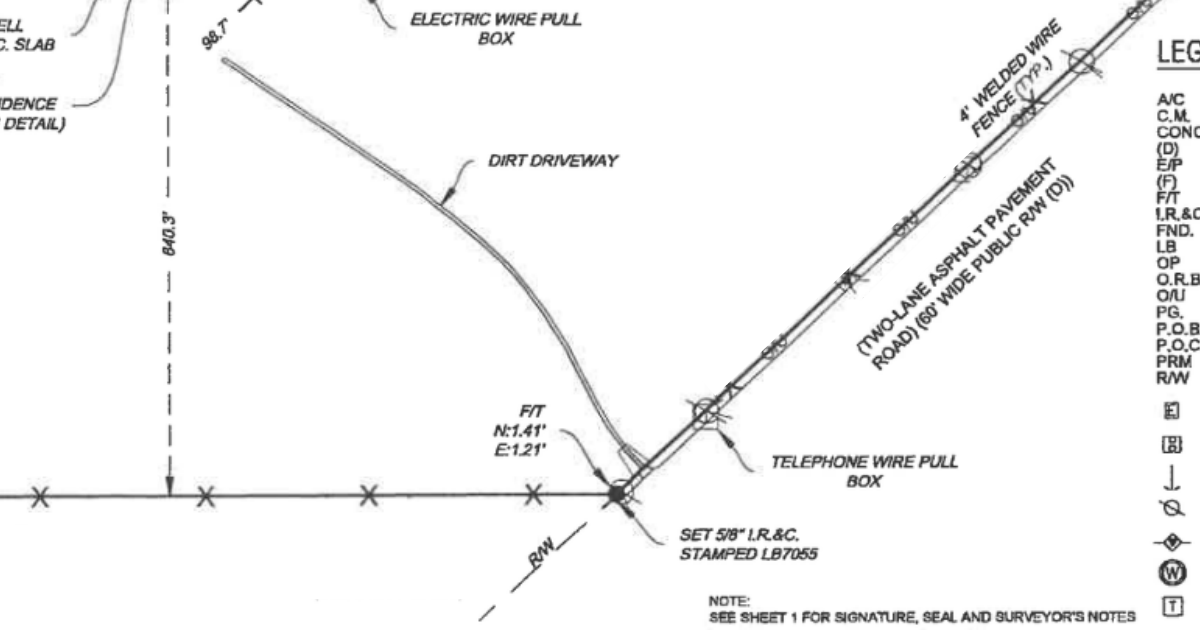
A property survey is a professional measurement and mapping of land that identifies legal property boundaries, dimensions, and other relevant physical features. It's performed by a licensed surveyor who researches property records, takes measurements, and prepares a drawing showing the property's boundaries and other information included in the survey's scope.
But surveys do more than tell you where your property lines are. They can also identify potential problems involving fences, structures, driveways, and easements that could affect how the property is used or transferred.
Understanding how property surveys work can help Tallahassee sellers avoid unexpected complications, help buyers understand what they're purchasing, and prevent costly surprises after closing.
Quick Links: What Is a Survey? | What Does It Show? | Easements & Encroachments | Property Lines | Types of Surveys | Who Pays? | Tallahassee Contract | Existing Surveys | Bottom Line
A property survey is a professional examination of a parcel of land that establishes or confirms its boundaries and documents relevant physical features.
In Florida, professional surveyors and mappers are licensed and regulated through the Florida Department of Agriculture and Consumer Services.
Surveyors use specialized equipment, property records, legal descriptions, and field measurements to determine where property boundaries are located.
For a typical residential transaction, the result is a survey drawing showing the property's dimensions, boundary lines, and certain improvements or conditions that may affect the land.
Think of it as a map of what you're actually purchasing, rather than simply what appears to belong to the property.
Just because a fence, driveway, or shed appears to be part of a property doesn't necessarily mean it's located entirely within the legal boundaries.
The information included depends on the type and scope of the survey, but a typical residential boundary survey may identify:
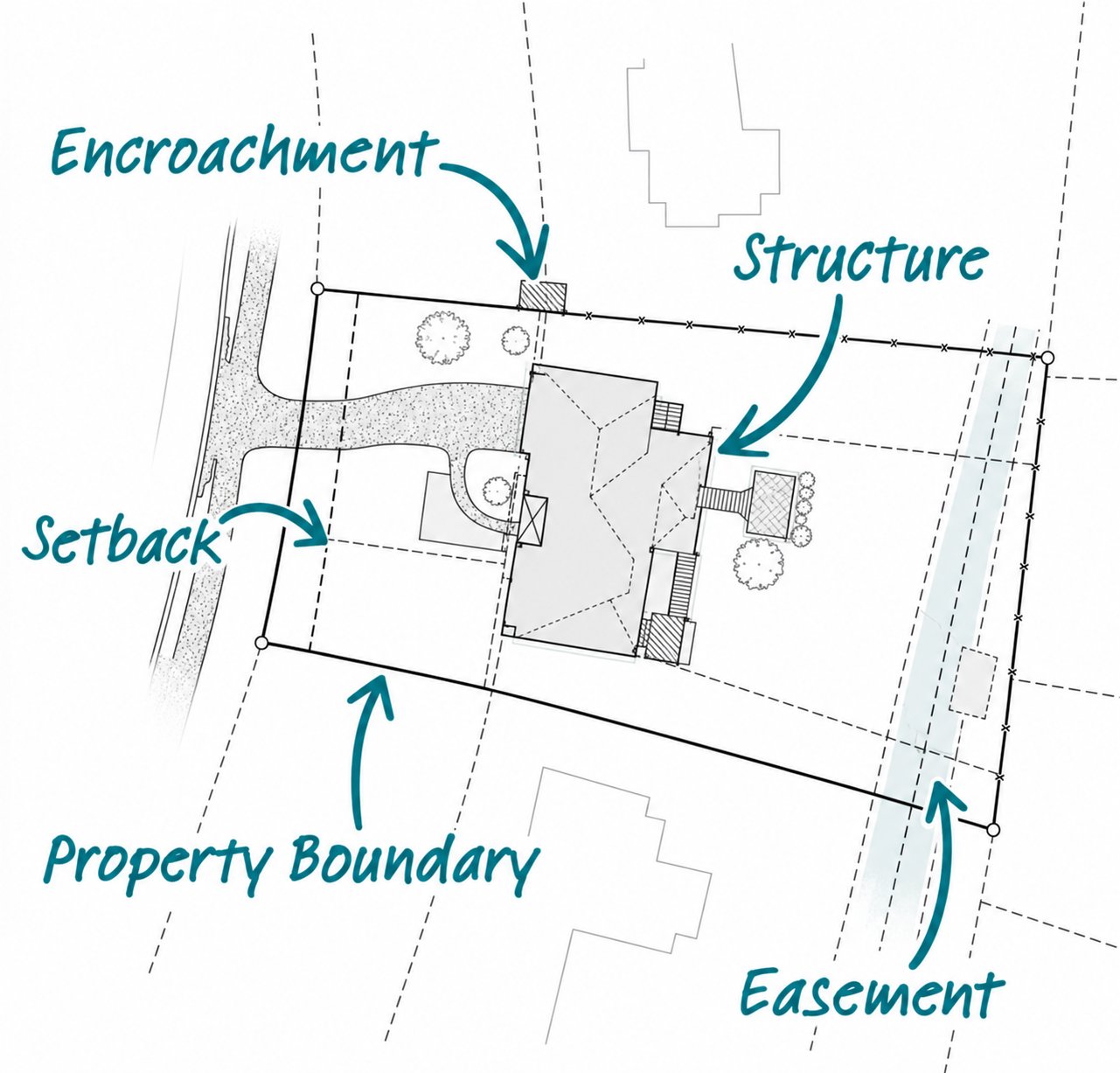
Not every survey includes all of these details. For example, an unrecorded easement may not appear unless it is identified during the surveyor's research or provided documentation.
Similarly, a boundary survey doesn't necessarily establish whether the property complies with every zoning, building, or development regulation.
However, the information it provides can reveal important differences between how a property appears and what the legal records and measurements establish.
Two of the most important issues a property survey can help identify are easements and encroachments.
What Is an Easement?
An easement is a legal right allowing another person, company, or entity to use a portion of a property for a particular purpose without owning that land.
For example, a utility easement might allow an electric company to access equipment or maintain power lines across part of a property.
Other easements may provide driveway access, drainage, or passage between properties.
Imagine purchasing a home with a large backyard, only to discover that a utility easement restricts where you can construct a pool or permanent structure.
The land may still belong to you, but the easement could limit how certain portions can be used.
What Is an Encroachment?
An encroachment occurs when a structure or improvement extends onto another person's property or into an area where it may interfere with another party's rights.
For example, your neighbor's fence might extend two feet onto your property, or part of your driveway might cross the neighboring property line.
Even relatively small encroachments can become important when selling a home, obtaining title insurance, or planning future construction.
In some cases, the issue can be resolved through an agreement, removal or relocation of an improvement, or another appropriate legal solution.
In others, a property boundary dispute may require additional surveying or legal assistance.
A survey provides important evidence about these conditions, but it does not automatically resolve a legal dispute over ownership or property rights.
There are several publicly available resources that provide information about property boundaries, including county property appraiser websites, subdivision plats, and Geographic Information System (GIS) maps.
In Tallahassee, many homeowners use the Leon County Property Appraiser website to research their property and view parcel maps.
These tools are helpful, but there's an important distinction.
A county parcel map is not the same as a professional boundary survey.
In fact, the Leon County Property Appraiser specifically states that its parcel map is not a substitute for a title search or land survey and should not be relied upon to determine property boundaries.
The same caution applies to fences, hedges, tree lines, and other physical features that appear to separate properties.
For example, in established Tallahassee neighborhoods such as Levy Park or Los Robles, a longstanding fence or landscaped boundary may not necessarily correspond to the property's legal boundary.
On larger parcels in Leon County, determining property lines, access routes, and easements can be particularly important when evaluating how the land may be used.
For accurate boundary information, a professionally prepared survey is generally the appropriate resource.
Yes. Not every property survey serves the same purpose.
Boundary Survey: Establishes or reestablishes the boundaries of a parcel. Depending on its scope, it may also show buildings, fences, driveways, and other improvements. This is commonly used in residential real estate transactions.
Topographic Survey: Measures land elevations, contours, and physical features. These surveys are often useful when planning construction, grading, or drainage improvements.
Construction or As-Built Survey: Documents the location of proposed or completed construction to help verify placement and compliance with applicable requirements.
Elevation Certificate: Provides specific elevation information often used in connection with flood insurance and floodplain management. An elevation certificate serves a different purpose from a standard boundary survey.
The type of survey needed depends on the property, the intended use, and any lender, title company, or governmental requirements.
In a real estate transaction, responsibility for ordering and paying for a survey is generally established by the purchase contract.
The Tallahassee Board of REALTORS® Contract for Sale and Purchase includes provisions allowing the parties to designate who will order the survey and who will pay for it.
Survey costs can vary depending on several factors, including:
A straightforward residential lot may require less work than a larger acreage property with irregular boundaries or limited existing documentation.
Because surveys can take time to complete, it's important to coordinate the order with the real estate agent, surveyor, lender, and closing agent.
Ordering too early could result in paying for a survey before other contingencies are satisfied. Waiting too long, however, could delay closing or leave insufficient time to address an unexpected issue.
The Tallahassee Board of REALTORS® Contract for Sale and Purchase specifically addresses surveys.
The contract advises buyers to obtain a survey on all transactions and establishes that an encroachment identified by a survey is treated as a title defect. Once the seller receives notice of the defect, the seller has 15 calendar days to resolve it at the seller's expense. If the defect cannot be cured within that period, the buyer may accept the title as-is or could terminate the contract according to its terms.
This matters because a newly discovered encroachment can affect whether the property can be conveyed under the agreed contractual terms.
For example, suppose a buyer orders a survey and discovers that the neighbor's fence extends into the property being purchased.
Depending on the circumstances, this could raise questions about the property's boundaries, ownership rights, or the ability to obtain satisfactory title insurance.
A seller generally has 15 days after receiving notice of a qualifying title defect to resolve it.
If the defect cannot be cured within the contractual period, the buyer may have the option to accept the title as-is or terminate the contract under the applicable provisions.
For sellers, this is why identifying boundary concerns before listing can be valuable. A survey issue discovered shortly before closing could create additional negotiations, unexpected expenses, or delays.
If you're selling a home in Tallahassee, you may already have a survey from when you purchased the property.
That survey can be a helpful starting point, but whether it can be reused depends on its age, accuracy, subsequent property changes, and the requirements of the lender or title insurance company.
For example, if a fence, addition, shed, or driveway was installed after the original survey, the drawing may no longer accurately reflect the property's improvements.
Property boundaries generally don't change simply because time has passed, but ownership records, physical conditions, and other relevant circumstances can change.
An existing survey may be accepted, require updating, or need to be replaced with a new survey.
For sellers, providing a copy of an existing survey before accepting an offer may also help identify potential concerns earlier in the process.
A survey affidavit may allow an existing survey to be used for closing when the seller certifies that certain conditions have not changed since the survey was completed.
However, keep in mind that signing an affidavit means making sworn statements about the property that could create liability if the information is inaccurate. Even if you haven't made any improvements yourself, changes involving neighboring fences, structures, or other property conditions may have occurred without your knowledge.
Having the buyer obtain a new survey can be a safer alternative to making statements about conditions that haven't been independently verified.
For buyers, relying on an existing survey and affidavit may save a few hundred dollars, but it also means relying on potentially outdated information about the property.
A survey affidavit does not physically verify property boundaries or identify new encroachments, easements, or improvements that may have occurred since the original survey. Even if the lender or title company accepts an existing survey, that doesn't necessarily mean every boundary issue is covered by title insurance.
We generally recommend that buyers consider obtaining a new survey before closing to better understand exactly what they're purchasing and identify potential problems while they still have an opportunity to address them.
A property survey is an important tool for understanding the land associated with a home, including its boundaries, improvements, easements, and possible encroachments.
It can provide a clearer understanding of the property they're purchasing and potential limitations on its use.
And while a survey might appear to be just another expense in the home-buying process, the information it provides can help avoid much more expensive problems in the future.
Because knowing where your property begins and ends is important. Knowing what comes with it is just as valuable.
This article provides general information based primarily on the Tallahassee Board of REALTORS® Contract for Sale and Purchase, revised March 2026. Individual transactions may involve different contracts, amendments, addenda, or statutory requirements. This article is not legal advice. Consult a Florida real estate attorney regarding specific contractual rights or disputes.
Stay up to date on the latest real estate trends.

All Real Estate News
November 3, 2026

All Real Estate News
November 2, 2026

All Real Estate News
November 2, 2026

All Real Estate News
October 31, 2026

All Real Estate News
October 30, 2026

All Real Estate News
October 29, 2026
You’ve got questions and we can’t wait to answer them.