Why Home Sales Fall Through & How You Can Prevent It
November 2, 2026
All Real Estate News

November 2, 2026
All Real Estate News
There's nothing quite like the excitement of accepting an offer on your home. The showings are behind you, the negotiations are over, and you're one step closer to your next chapter.
But there's one important detail: Going under contract and making it to closing aren't quite the same thing.
What happens when the inspection uncovers unexpected repairs, the buyer's financing falls through, or someone simply changes their mind?
According to Redfin, 14.5% of U.S. home purchase agreements fell through in September 2026. Meanwhile, Florida metros like Jacksonville and Tampa experienced cancellation rates approaching 20%.
This raises an important question for homeowners: What can sellers do to reduce the chances of a deal falling apart?
Fortunately, many of the issues that derail a home sale can be anticipated before a property ever goes under contract.
Before assuming that national headlines tell the whole story, let's look at what's actually happening in Tallahassee.
According to Florida Realtors® SunStats, the Tallahassee single-family housing market recorded 3.8 months of inventory in September 2026, unchanged from the previous year.
Homes went under contract in a median of 32 days, compared with 54 days in September 2025. Meanwhile, sellers received a median of 97% of their original asking prices.
That's an interesting combination.
Homes that went under contract were doing so faster than a year earlier, but sellers weren't necessarily getting everything they initially asked for.
These numbers don't tell us how many local contracts were canceled. However, they help explain why setting realistic expectations remains important.
A seller who receives an offer may have already spent weeks preparing, marketing, and showing their property. If that contract falls apart, starting over can mean additional carrying costs, missed opportunities, and more time on the market.
That's why evaluating an offer should involve more than the purchase price.
In a Redfin survey of 443 real estate agents who had experienced canceled transactions, three issues stood out: inspections, financing, and buyers who couldn't sell their existing homes.
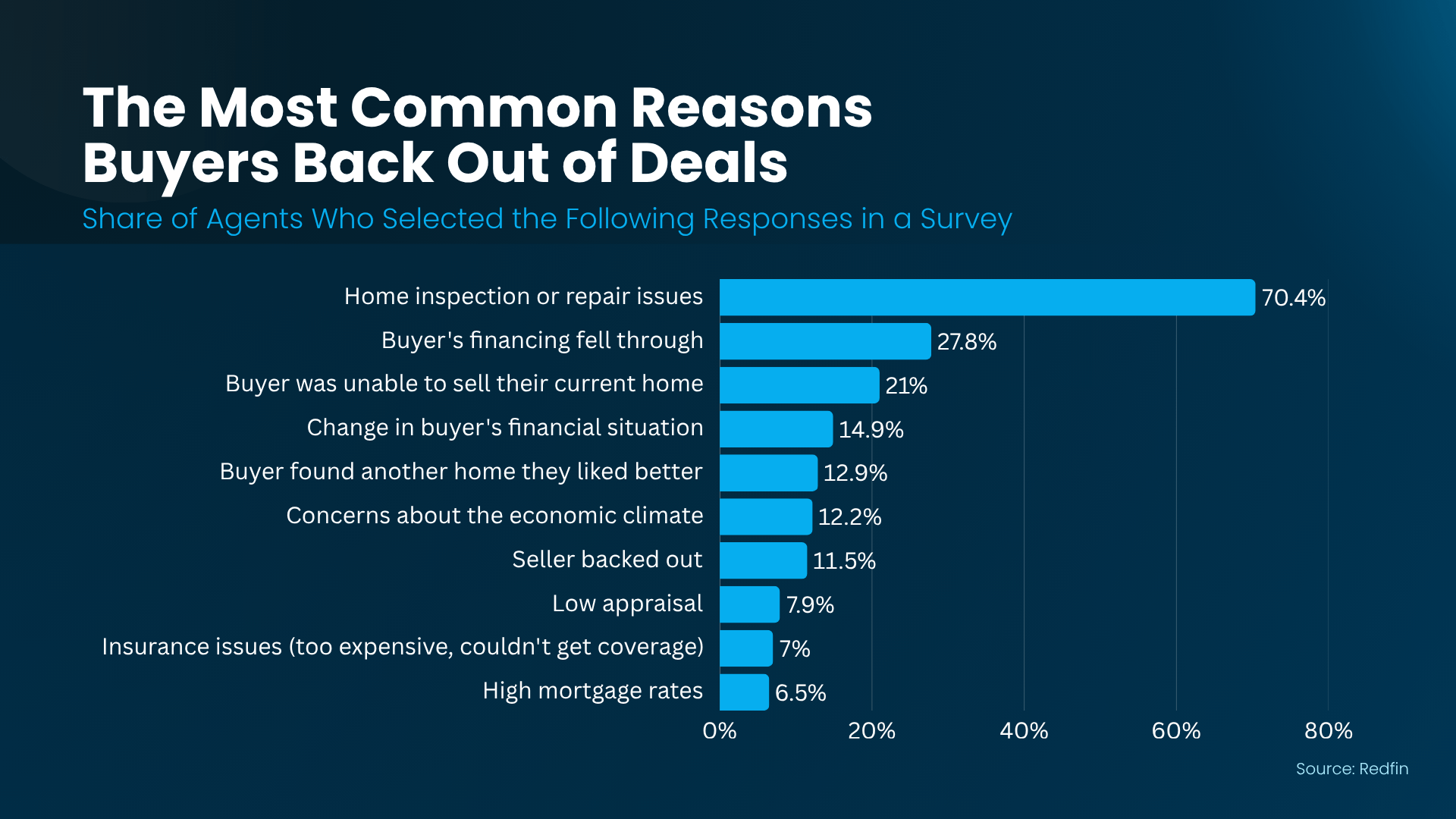
The percentages represent agents who identified each issue, rather than the percentage of transactions canceled for that specific reason.
Let's take a closer look at how these challenges can affect homeowners and what sellers can do to prepare.
This was by far the most commonly reported reason for canceled contracts in Redfin's survey.
The age, construction, and condition of a property can make a significant difference in what an inspection reveals.
Depending on the home, inspections may identify concerns involving:
Not every inspection finding is a deal-breaker. Most homes have some maintenance needs, and buyers shouldn't necessarily expect a perfectly clean inspection report.
But unexpected problems, particularly expensive ones, can quickly change the conversation.
How Sellers Can Prepare
Consider a pre-listing inspection, particularly if your home is older or you have concerns about its condition.
A pre-listing inspection may help identify problems before a buyer does, giving you more time to evaluate repairs, obtain estimates, and develop a realistic pricing strategy.
That doesn't mean you have to repair everything before listing.
Sometimes completing a repair makes financial sense. Other times, disclosing the condition, pricing accordingly, or negotiating a credit may be the better approach.
Florida sellers also have an obligation to disclose known facts that materially affect the property's value and are not readily observable or known to the buyer. Selling a home "as is" does not eliminate that obligation.
Ultimately, an inspection by the buyer shouldn't be the first time a seller learns about a major problem with their property.
One of the best ways to get ahead of potential surprises is to consider a pre-listing home inspection before putting your home on the market. Rather than waiting for a buyer's inspector to uncover an issue halfway through the transaction, a pre-listing inspection gives sellers an opportunity to identify potential concerns, obtain repair estimates, and make informed decisions about what to address before listing.
Understanding your home's condition before accepting an offer can help establish realistic expectations, reduce unexpected negotiations, and potentially lower the risk of a contract falling through. Just remember that a pre-listing inspection doesn't replace the buyer's inspection or your disclosure obligations under Florida law.
An accepted offer doesn't mean the mortgage has been approved.
Even buyers with pre-approval letters may encounter problems during underwriting, appraisal, or the final stages of obtaining financing.
And affordability remains a significant concern.
Between mortgage rates, property taxes, homeowners insurance, and other ownership expenses, the monthly cost of purchasing a home can be higher than some buyers initially anticipate.
The property's condition and insurability can also affect financing.
For example, an aging roof or another property-related concern may lead to additional lender requirements or difficulty obtaining acceptable insurance coverage.
How Sellers Can Prepare
Before accepting an offer, sellers should work with their real estate agent to understand the financing terms, including the type of loan, applicable contingencies, and the buyer's documented financing readiness.
A pre-approval letter can be helpful, but it isn't a guarantee.
It's also important to consider whether the purchase price is supported by comparable sales. If the property appraises below the agreed purchase price, the parties may need to renegotiate, or the buyer may need additional funds, depending on the financing and contract terms.
And when affordability is the concern, sellers may be able to negotiate closing cost assistance or other concessions, subject to the buyer's loan program and lender requirements.
The highest offer isn't always the strongest offer. Understanding the likelihood of getting to closing can be just as important as the price on the contract.
Sometimes, selling one home depends on successfully selling another.
A buyer may need proceeds from their existing property to fund the down payment or otherwise qualify for financing on your home.
That can create a chain of transactions.
If the buyer's existing home doesn't sell, their financing may become more complicated, potentially affecting your closing.
How Sellers Can Prepare
When an offer includes a home-sale contingency, understanding the buyer's situation becomes especially important.
Is their existing home already under contract? Has it completed inspections? Is it still being marketed? Does the contract include specific deadlines or provisions addressing the contingency?
These details can affect the amount of uncertainty a seller is accepting.
A real estate agent can help evaluate the terms of the offer and discuss potential protections, such as negotiated contingency deadlines, where appropriate.
The objective isn't necessarily to reject offers with contingencies. It's to understand the risks before making a commitment.
Here's another important piece of the puzzle.
Many local transactions use contract provisions that allow buyers time to investigate the property's condition, insurance availability, financing, and other matters before closing.
The Tallahassee Board of REALTORS® contract commonly provides a 15-calendar-day inspection contingency period, although the exact terms may vary based on the contract and negotiations.
Depending on the agreement, buyers may have the contractual right to terminate during an applicable contingency period.
That means a deal can fall apart even when both parties initially intended to close.
For sellers, understanding these deadlines is essential. It helps you anticipate when inspections, financing decisions, and other important milestones should occur.
We've covered these provisions in more detail in our guide to Understanding the Contingency Period and Due Diligence as a Home Seller.
Insurance may not be among the top three reasons identified in Redfin's survey, but it's still worth addressing.
Depending on the property, a buyer may encounter concerns involving roof condition, prior damage, flood risk, or the cost of obtaining acceptable coverage.
Addressing known property concerns and making relevant documentation available early can help reduce last-minute surprises.
Florida law also requires sellers of residential real estate to provide a flood disclosure at or before execution of the sales contract.
Being proactive with accurate disclosures, maintenance documentation, and available repair records can help everyone make more informed decisions.
Absolutely. A canceled contract doesn't automatically mean there's something wrong with your property or that it won't sell.
Sometimes the buyer's circumstances change. Sometimes financing doesn't work out. And sometimes an issue arises that can be addressed before the next offer.
The important thing is to understand why the previous transaction failed and determine whether anything should change before returning to the market.
That could mean making a repair, updating disclosures, adjusting the price, or simply finding another qualified buyer.
If a contract is still legally in effect, however, sellers should make sure any termination and release issues are properly addressed before entering into another agreement. The appropriate steps depend on the contract, and legal advice may be necessary if there is a dispute.
An accepted offer is an exciting milestone, but there's still work to be done before closing day.
For Tallahassee homeowners, a successful sale involves more than attracting an interested buyer. It requires realistic pricing, thoughtful preparation, careful evaluation of offers, and a clear understanding of the contract.
While you can't eliminate every possible complication, you can make informed decisions that may reduce the risk of unexpected problems.
Because the goal isn't just to get your home under contract. It's to get it sold.
Stay up to date on the latest real estate trends.

All Real Estate News
November 3, 2026
All Real Estate News
November 2, 2026

All Real Estate News
November 2, 2026

All Real Estate News
October 31, 2026

All Real Estate News
October 30, 2026

All Real Estate News
October 29, 2026
You’ve got questions and we can’t wait to answer them.